.png)
.webp)





.webp)
SEO
Calculating...
Aug 2026
Crypto SEO in 2026: The Complete Guide
Crypto SEO in 2026: rank crypto and Web3 sites in Google and AI search. Technical fixes, GEO, compliance and a proven agency playbook from MADX.


The cryptocurrency industry is one of the most competitive and fast-moving sectors online. Crypto companies deal with regulatory uncertainty, technical complexity, and a constant need to educate and reassure their audiences. Search is where most of that education begins.
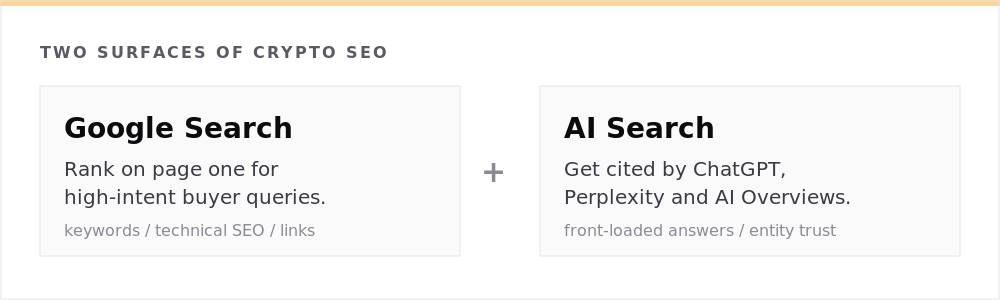
Crypto SEO is the practice of optimising a cryptocurrency or Web3 website so it ranks in Google and gets cited in AI search tools like ChatGPT, Perplexity and Google AI Overviews. It combines keyword-targeted content, technical SEO, authoritative links and clear trust signals to reach high-intent buyers, without paying for every click.
As an SEO agency, we see the same pattern across campaigns: the brands that win organic visibility treat search as a trust-building channel, not just a traffic channel. This guide covers why crypto SEO matters in 2026 and the elements that win visibility across both Google and AI search.
Why is SEO Important for Crypto?
The crypto sector runs on credibility. Buyers research wallets, exchanges and protocols before they trust them with money, and most of that research still starts with a search box or, increasingly, an AI assistant. Unlike paid ads, SEO compounds: rankings and citations you earn keep sending qualified traffic long after the work is done.
Driving Organic Traffic
Organic traffic is the foundation of crypto visibility. SEO helps your site rank for the terms buyers actually use, from "buy Bitcoin" to "best crypto wallet" to "secure crypto trading platform." These visitors arrive with intent, which means lower bounce rates and higher conversion than most paid channels. Because organic authority builds over time, the traffic tends to compound rather than stop the moment a budget runs out.
Establishing Credibility and Trust
Trust is the scarcest commodity in crypto. According to Pew Research (2024), about 63% of Americans have little or no confidence that using or investing in cryptocurrency is safe and reliable, and only 5% are extremely or very confident. Ranking on page one signals legitimacy in a market still shadowed by scams and failures.
Detailed, accurate content marketing campaigns, published under named authors with real expertise, are how you turn a first-time visitor into someone who trusts your brand. Guides like "How to Store Cryptocurrency Securely" or "Blockchain Technology Explained" position you as a reliable source, which drives long-term loyalty.
Achieving Conversions
Search visitors often arrive mid-decision: "crypto payment gateway," "Ethereum wallet setup," "best crypto trading app." Matching that intent with a focused page, then removing friction with clear landing pages and navigation, is what converts a query into a sign-up. SEO does not just bring traffic, it brings the right traffic to the right page.
Beating the Competition
Crypto is crowded and volatile. CoinGecko now tracks more than 17,000 cryptocurrencies as of 2026, and its own analysis finds that more than half of all listed tokens have already failed. The total crypto market cap sat near $2.3 trillion in July 2026, well down from its $4.27 trillion peak in October 2025 (CoinGecko). A cooling market is exactly when SEO earns its keep: paid budgets get cut first, while organic rankings and AI citations keep compounding. SEO gives you a structural edge: target the niches and long-tail queries competitors ignore, build better content on the topics they cover thinly, and earn the authority that keeps you ahead. It works: for crypto payments platform MoonPay, MADX grew organic traffic 175% to 433,317 monthly visitors (MoonPay case study).
Understanding the Crypto Landscape
A winning SEO strategy starts with the market it sits in. These are the trends, challenges and search dynamics shaping crypto in 2026.
Trends Shaping the Crypto Industry
- Mass adoption: Global crypto ownership reached roughly 741 million people in 2025, up 12.4% from 659 million in 2024. Bitcoin owners alone grew to about 365 million.
- DeFi and tokenisation: Total value locked climbed back above $170 billion in 2025. Tokenisation of real-world assets is now the fastest-growing segment, pulling in institutional as well as retail money.
- Tighter regulation: Governments continue to formalise crypto rules, from the EU MiCA framework to enforcement against non-compliant offshore exchanges. Clear, compliant content is now a ranking advantage, not just a legal box to tick.
- A global audience: Adoption is strongest in emerging markets across Asia, Africa and Latin America, per the Chainalysis 2025 Global Adoption Index. Multi-language and multi-region SEO is essential to reach these buyers.
Common Challenges for Crypto Companies
- Educating audiences: Blockchain is complex, and understanding lags adoption. With only 5% of Americans "very confident" in crypto (Pew, 2024), beginner-friendly guides, FAQs and glossaries are some of the highest-leverage content you can publish.
- Building trust: Fraud and high-profile collapses have made buyers cautious. Security disclosures, audits, proof of reserves and transparent operations are trust signals that also help search engines and AI models judge your credibility.
- Standing out: With more than 17,000 tracked cryptocurrencies, differentiation is hard. Niche targeting, a clear value proposition and disciplined SEO are how smaller players win visibility they could never buy.
The Role of SEO and AI Search
Search is no longer only Google. Buyers now research inside AI tools too, and the scale is real: ChatGPT passed 900 million weekly active users by mid-2026. At the same time, Google zero-click searches hit 68% in early 2026, as AI Overviews answer more queries on the results page itself. For crypto brands, that means optimising for two outcomes at once: ranking in Google, and being the source AI engines quote when someone asks "what is the safest crypto wallet?"
The rest of this guide covers the fundamentals that drive both. For a broader primer, see our SEO blog and our blockchain SEO guide.
Key Elements of SEO for Crypto
Every effective crypto SEO strategy rests on four pillars. Each one now has an AI-search dimension as well as a classic-SEO one.
Keyword Research for Crypto
Keyword research maps what your buyers search and how much competition each term carries. Group targets by intent: informational ("how does blockchain work?"), transactional ("buy Ethereum securely"), and navigational ("best crypto SEO agency"). Long-tail queries like "how to set up a Bitcoin wallet on mobile" are lower competition and convert well. For infrastructure and dApp projects, do not overlook developer-intent queries such as "X API integration" or "X smart contract audit", a high-value cluster most competitors ignore. Use our keyword research guide for the MADX process, and Ahrefs guide to keyword research for a deeper walkthrough.
On-Page SEO Strategies
On-page SEO aligns each page with a target query and makes it easy to read for people and machines. Write genuinely useful content, use keywords naturally, and keep a clean heading structure (one H1, logical H2s and H3s). Optimise metadata, add descriptive alt text to every image, and refresh pages as the market moves. See our on-page SEO guide for the full checklist.
Technical SEO for Crypto
Technical SEO makes sure engines and AI crawlers can reach and understand your site. Prioritise fast load times, mobile responsiveness, HTTPS, and clean site architecture. Add schema markup so engines can parse your content, and check that your robots.txt does not accidentally block AI crawlers such as GPTBot, ClaudeBot and PerplexityBot. Use our technical SEO guide alongside Ahrefs technical SEO guide and Google crawling and indexing documentation.
Content Marketing and Link Building
Strong content and authoritative links are what turn a technically sound site into a trusted one. Publish educational guides, original data and clear explainers, then earn links through digital PR, data-driven reports and listings in reputable crypto directories like CoinGecko and CoinMarketCap. Vet your backlink profile ruthlessly: crypto is a prime target for PBNs and paid-link schemes, and a spammy profile is a trust liability for both Google and AI models, so audit and disavow. Beyond written guides, user reviews, community answers and short explainer video are content types that build the trust crypto buyers demand. Pair our link building guide with Ahrefs link building guide for the wider tactics.
Crypto-Specific Technical SEO Challenges
Crypto sites break in ways ordinary SaaS sites do not, and most of the damage is invisible until an audit surfaces it.
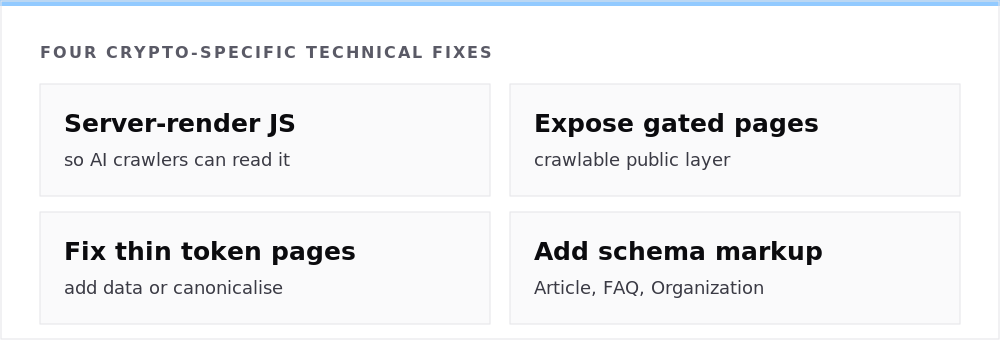
JavaScript rendering and AI crawlers. Many crypto and Web3 products are single-page apps that render content with JavaScript. Google can usually render it, but most AI crawlers cannot: GPTBot, ClaudeBot and PerplexityBot fetch your raw HTML and largely skip client-side JavaScript. If your token data, docs or key copy only appear after a script runs, AI engines simply do not see them. Server-side render or pre-render anything you want ranked or cited.
Wallet-connect and gated pages. "Connect wallet" flows, gated dashboards and app subdomains often sit behind interactions crawlers never complete, leaving thin or empty pages in the index. Keep a crawlable, content-rich public layer for every page you want to rank, separate from the authenticated app.
Thin and duplicate token pages. Auto-generated coin, pair and price pages tend to be near-identical. Add unique data, context and internal links, or consolidate with canonical tags so they do not dilute one another.
Structured data and multi-region. Mark up articles, FAQs and your organisation with schema so engines and AI models can parse them cleanly, and use Product or dataset markup for token and price pages where it genuinely applies. Because adoption is strongest in emerging markets, implement hreflang and localised content properly rather than machine-translating one page.
Programmatic SEO for Crypto at Scale
Crypto is one of the few niches where programmatic SEO, generating many pages from a structured template and a data source, genuinely fits search demand. Buyers search predictable patterns at scale: "how to buy [coin]", "[coin] price prediction", "[exchange A] vs [exchange B]", "is [token] safe". A well-built template that answers one of these patterns across hundreds of assets can capture a long tail no hand-written guide could.
The risk is the same thing that makes it powerful: scale multiplies thin content. Each page needs a genuine reason to exist, whether live data, a unique comparison or a real answer, not a spun paragraph with the coin name swapped in. Set a quality floor per page, canonicalise near-duplicates, and keep templates behind a crawlable, fast, server-rendered layer so both Google and AI engines can read them. Done with discipline, programmatic pages become the widest part of your funnel; done lazily, they trigger the exact thin-content and spam signals that sink crypto domains.
Compliance, Disclosures and E-E-A-T: Trust as a Ranking Factor
Crypto is a textbook "Your Money or Your Life" topic, so Google and AI engines apply a higher bar before they rank or cite you. Compliance is no longer just a legal box; it is a ranking input.
Regulation is now explicit. The EU MiCA framework, tightening US enforcement and similar regimes worldwide mean that clear, compliant, accurate content is rewarded and misleading claims are penalised. Pages that make unqualified return promises age badly and attract exactly the manual actions you want to avoid.
The signals that satisfy regulators also satisfy E-E-A-T. Publish under named authors with verifiable expertise. Add risk disclosures, dates and sources. Surface security posture, such as audits, proof of reserves and incident history, because these are the corroborating facts a cautious buyer and a cautious algorithm both look for. With only about 5% of Americans "very confident" in crypto (Pew, 2024), demonstrated trustworthiness is a competitive moat, not a compliance chore. It matters doubly for AI search: engines weigh how consistently your brand is corroborated across independent sources.
How AI Search Is Reshaping Crypto SEO
AI search is the biggest shift crypto SEO has seen since mobile. Generative Engine Optimisation (GEO) is the practice of structuring content so AI answer engines can extract and cite it. The good news: the fundamentals that rank you in Google are also what get you quoted by AI. The work is in making your answers easy to lift and your brand easy to trust.
Generative Engine Optimisation (GEO)
Lead every section with a direct answer, then explain. Definition-first sentences ("A crypto wallet is...") get pulled into AI answers far more readily than buried explanations. Break content into self-contained passages, use comparison tables and clear question-style headings, and cite current statistics with the source named inline. Google own guide to optimising for AI features confirms that these features are rooted in core Search quality systems, so good SEO and good GEO reinforce each other.
AI Overviews and the Trust Bar for Crypto
Because crypto is a "Your Money or Your Life" topic, AI engines and Google apply a higher trust bar before they cite you. That rewards clear authorship, risk disclosures, dates, and consistent entity signals. As Google Head of Search Liz Reid put it, describing what wins clicks in AI Overviews:
"What we see on what people click on, on AI Overviews, is content that is richer and deeper." Liz Reid, Head of Google Search (Search Engine Land, 2025)
The practical takeaway for crypto: surface-level, thin content will not be cited or clicked. Depth, named sources and genuine expertise will.
Entity Trust and Brand Corroboration
AI models do not simply count how often your brand is mentioned; they weigh how consistently it is corroborated across independent sources. Entity SEO specialist Jason Barnard sums it up:
"AI evaluates confidence, it doesn't count mentions." Jason Barnard, entity SEO specialist (Search Engine Land, 2026)
For a crypto brand that means aligning your site, schema, author profiles and third-party mentions so they tell one consistent story. Research by Rand Fishkin team, which ran nearly 3,000 identical prompts across ChatGPT, Claude and Google AI, found fewer than 1 in 100 runs returned the same list of brands, so the brands that show up reliably are the ones corroborated from many angles. Consistent digital PR and link building is how you build that corroboration.
Common Crypto SEO Mistakes to Avoid
Most crypto sites lose rankings to a short list of avoidable errors.
- Buying spammy links. Crypto is saturated with link schemes and PBNs. Cheap bulk links are a liability: they read as manipulation to Google and as untrustworthy corroboration to AI models. Earn links through digital PR, data and genuine partnerships instead.
- Blocking AI crawlers by accident. An over-zealous robots.txt or firewall rule that blocks GPTBot, ClaudeBot or PerplexityBot removes you from AI answers entirely. Audit crawler access deliberately.
- Shipping thin token pages. Hundreds of near-identical auto-generated pages dilute authority and invite thin-content demotions. Add value or consolidate.
- No named authors or expertise. Anonymous YMYL content struggles. Real author bios, credentials and disclosures lift both rankings and citation odds.
- Keyword stuffing and over-optimisation. Crypto pages often cram "buy [coin]" variants unnaturally. Write for the reader; engines and AI models reward clarity.
- Chasing only head terms. Competing head-on with exchanges for "buy bitcoin" wastes budget. Win the informational and long-tail queries first, then grow into competitive terms.
- Ignoring internal links and freshness. Orphaned guides and stale stats quietly erode trust. Interlink related content and refresh dated figures on a schedule.
Measuring SEO Success
Track the metrics that connect SEO to revenue, and add AI visibility to the list:
- Organic traffic and rankings: monitor sessions and target-keyword positions with your analytics and rank tracker, tied to the SEO KPIs that matter.
- Conversions and holder growth: sign-ups, wallet creations, verified accounts and token-holder or active-user growth attributable to organic, not just visits.
- Engagement: bounce rate and time on page flag content or intent mismatches.
- Backlink profile: the quantity and quality of links pointing to your site.
- AI visibility (share of voice): how often your brand is cited in ChatGPT, Perplexity and AI Overviews for your priority queries.
Ready to Grow Your Crypto Business with SEO?
SEO is no longer optional for crypto companies. It is how you build visibility and trust across both Google and AI search. With tailored crypto SEO services, you can rank for high-intent terms, become the source AI engines cite, and grow sustainably. Book a call with MADX and take the first step.
Frequently Asked Questions
What is crypto SEO?
Crypto SEO is the practice of optimising a cryptocurrency or Web3 website so it ranks in Google and gets cited in AI search tools. It combines keyword research, on-page and technical SEO, content, and authoritative links, with extra weight on trust signals because crypto is a high-scrutiny, Your-Money-or-Your-Life topic.
How is crypto SEO different from regular SEO?
The mechanics are the same, but the trust bar is far higher and the technical surface is different. Crypto is a Your-Money-or-Your-Life topic, so E-E-A-T signals (named authors, risk disclosures, audits, consistent entity data) carry more weight than in most niches. On the technical side, Web3 sites add wallet-connect flows, JavaScript-heavy dApps and scaled token pages that ordinary SEO never has to handle. Compliance and clarity are ranking factors, not afterthoughts.
How much does crypto SEO cost?
It varies with scope and competitiveness. Specialist crypto and blockchain SEO retainers commonly run from around $3,000 to $15,000+ per month, with some agencies pricing link building per placement. What matters more than the sticker price is the model: organic SEO compounds, so the right benchmark is cost per acquired user or per dollar of pipeline over 6 to 12 months, not cost per click. Ask any agency for crypto-specific case studies before you commit.
What are the most common crypto SEO mistakes?
The big ones are buying spammy links, accidentally blocking AI crawlers in robots.txt, publishing hundreds of thin auto-generated token pages, running YMYL content with no named authors or disclosures, and chasing head terms like buy bitcoin instead of winnable long-tail queries. Fixing these usually moves rankings faster than adding new content.
Does AI search matter for crypto companies?
Yes. With ChatGPT past 900 million weekly users and most Google searches now ending without a click, buyers increasingly research crypto inside AI tools. Structuring content so AI engines can quote it (clear answers, named sources, consistent brand signals) is now part of core crypto SEO, not a separate project.
How long does crypto SEO take to work?
Most crypto sites see meaningful movement in three to six months, with compounding gains after that. Technical fixes and on-page improvements can lift rankings quickly; authority and AI citations build over a longer horizon as links and corroboration accumulate.
Can new or small crypto projects rank against big exchanges?
Yes, by focusing. Target niche and long-tail queries the incumbents cover thinly, publish genuinely expert content, and earn trusted links. Smaller players regularly win visibility on specific topics long before they could compete for the biggest head terms.

Latest articles
What we've published in the past 30 days — across SEO, GEO, content, and digital PR.

.png)