GEO
Calculating...
Apr 2026
Your Brand Was Recommended by Google AI. So Why No Click?
AI Overviews can recommend your SaaS brand without sending the visit. Learn how click rerouting affects SEO, GEO, PPC, and attribution.

Someone searches best CRM software. Google shows an AI Overview with a shortlist of vendors.
Your brand is there. That should feel like a win. But you're not seeing a click through to your website.
Maybe they click a citation. Maybe they search your brand name next. Maybe they come back later through a branded ad, a review site, or direct traffic. Maybe they never click out at all.
This is a new problem SEO's and marketers are having to deal with.
Your brand may have won visibility at the buying stage without winning the click or the attribution. For SaaS marketers, founders, and SEO leads, that creates a new blind spot across SEO, GEO, and paid search.
Google has described AI Overviews as a way to provide “a quick overview of a topic and links to learn more”.

That is true at a high level.
But for software buyers, the path from recommendation to website visit is getting much less direct.
What we'll cover:
TL;DR
- AI Overviews can mention software brands without sending users directly to those brand websites
- In some cases, the next action behaves more like another Google search than a website click
- That means the original AI Overview may influence the buying journey while another channel gets the credit
- This is why “zero-click” is too narrow. A better framing is click rerouting or click redistribution
- Teams should track buyer-query visibility, branded search lift, PPC pressure, citation sources, and downstream conversions together
Your brand is recommended, but no clicks?
The old model was messy, but understandable.
A buyer searched something like best help desk software. They clicked a listicle, a review site, or a vendor page. Then they compared options and eventually visited a few brand websites.
The click path was not perfect, but it was visible enough to report on.
AI Overviews change the order of events.
Now Google can answer the category query itself. It can name a shortlist of brands inside the results page before the user ever reaches a comparison article.

That sounds positive for the brands that get mentioned.
But an AI mention is not the same thing as a website visit.
The user might click a source citation instead of your site. They might refine the search. They might search your brand later. They might click an ad on the follow-up search. Or they might stop after reading the answer.
So yes, your brand may have influenced the buying decision.
But no, that influence may not show up as a clean session to your site.
Is this a zero-click issue?
A lot of the conversation around AI Overviews uses the phrase zero-click.
That framing is useful, but incomplete.
Sometimes no click happens. But sometimes a click does happen, just not in the way marketers expect.
It may go to a source citation. It may stay inside Google as another search. It may lead to a branded search later, followed by an organic click, a paid click, or a visit through a review site.
That is why the better framing is click rerouting.
Or, at a broader level, click redistribution.

The buyer journey is being split across multiple surfaces. SEO or GEO may create the discovery moment. Reporting may give the credit to whatever gets the last visible click.
That might be branded organic. It might be branded PPC. It might be direct traffic. It might be a review platform.
This is where the real attribution problem starts.
What happens when someone clicks your brand?
There are a few different outcomes.
1. No click at all
The buyer gets enough information from the AI Overview and stops there.
This is the purest version of the zero-click problem.
2. The click behaves like another Google search
This is the key mechanic to understand.
Google Search Console documentation explains query refinements as clicks that perform another Google search instead of sending the user to an external website.
So if someone clicks your brand inside an AI Overview and Google opens a brand search results page, that is not a normal referral to your site. It is a new search.
In plain English, the buyer feels like they clicked your brand.
In reporting terms, they may still be inside Google.
3. A click goes to a citation source, not your site

The next step may be a third-party article, review site, Reddit thread, or another cited source.
Your brand was part of the answer. Another publisher gets the visit.
4. A later branded search leads to organic or paid traffic
This is where things get blurry.
A user searches best CRM software. Google’s AI Overview mentions HubSpot. The user clicks HubSpot in the answer. Google opens a HubSpot search result instead of HubSpot.com. Then the user clicks a branded ad or organic listing.
Now PPC or branded organic gets the credit, not the AI visibility moment that shaped the shortlist.

The issue is not only whether AI Overviews remove clicks. It is that they can change what a brand click actually means, which is why AI Overview optimization has to be measured beyond simple organic sessions.
Buyer-intent queries are moving into AI Overviews
If AI Overviews only showed up for lightweight informational searches, this would matter less for software companies.
But that is not what the data suggests.
Semrush found that in January 2025, 91.3% of AI Overview-triggering queries were informational. By October 2025, that had fallen to 57.1%.
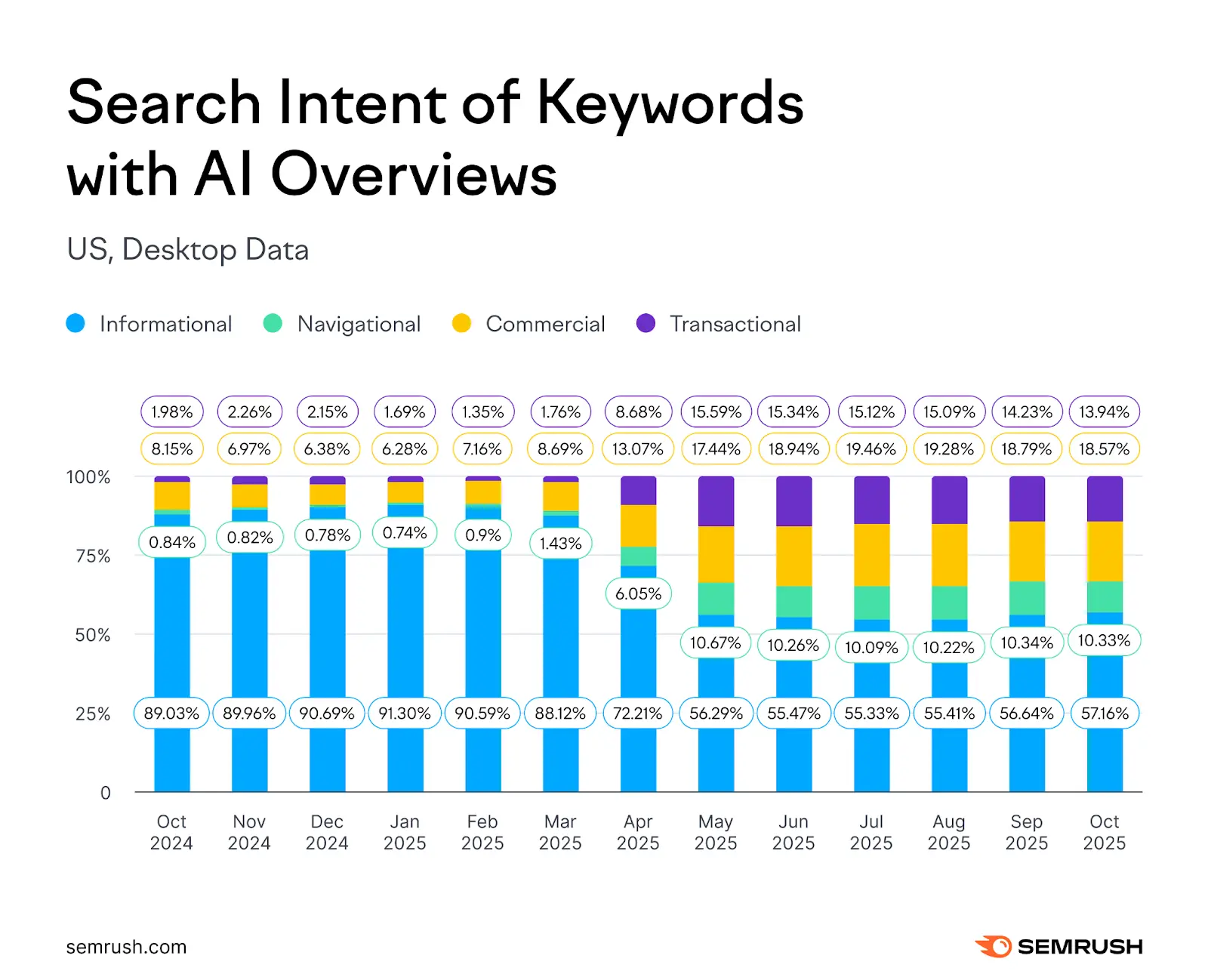
Over the same period:
- Commercial queries rose from 8.15% to 18.57%
- Transactional queries rose from 1.98% to 13.94%
- Navigational queries rose from 0.84% to 10.33%
That matters because these are the kinds of searches SaaS buyers actually use:
- best [category] software
- [category] software for [use case]
- [brand] alternatives
- [brand] vs [competitor]
- top [category] platforms
Google is moving deeper into the part of search where software buying decisions happen.
That means AI visibility is getting closer to revenue. It also means attribution gets harder right where it matters most.
Are clicks are getting compressed?
There is now plenty of evidence that AI Overviews reduce clicks to traditional search results.
Pew Research Center found that users clicked a traditional search result in 8% of visits with an AI summary, compared with 15% without one. It also found that users clicked an AI summary source link in only 1% of visits where an AI summary appeared.

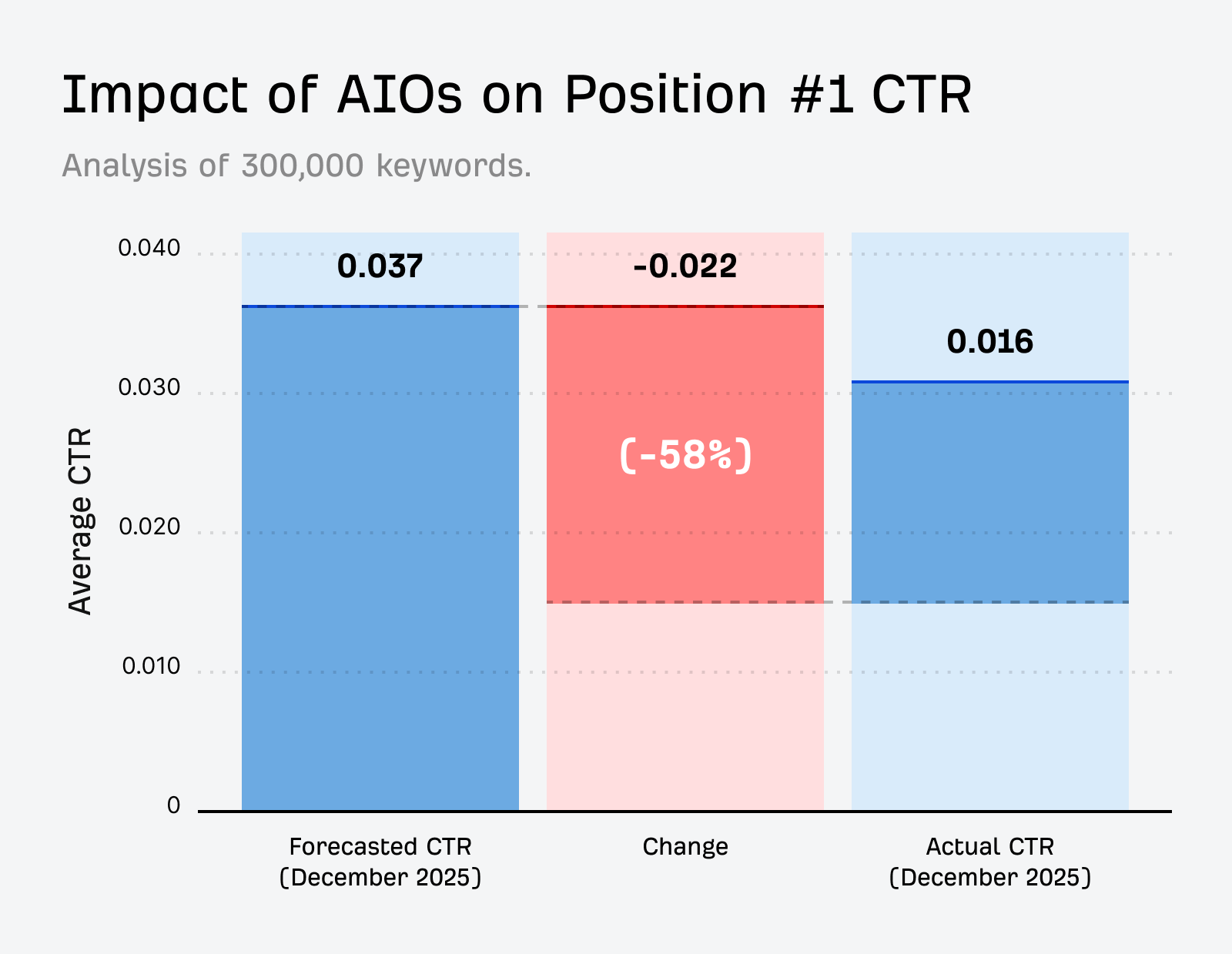
Ahrefs found a 34.5% lower average CTR for the top-ranking page when AI Overviews appeared in 2025. Its 2026 update found the top-ranking page had a 58% lower average CTR in December 2025 data.
Amsive found non-branded CTR fell 19.98% on AIO-triggering keywords.
So yes, clicks are getting compressed.
Malte Landwehr put it:“The average is -40%. The median is -37%.”

But zero-click still does not explain everything.
Semrush found that on same-keyword comparisons, zero-click actually declined slightly after an AI Overview appeared, from 33.75% to 31.53%.
That nuance matters.
It suggests AI Overviews are not only removing clicks. They are redistributing attention and changing where the next click happens.
That next click may simply be happening somewhere else in the journey.
Google AI may influence the conversion without attribution
This is the part most teams will feel before they can clearly explain it.
Google says AI Overviews and AI Mode are part of normal Search, not a separate referral source.
Search Console includes AI feature traffic inside the normal Web search type.

GA4 classifies non-ad clicks from AI Overviews and AI Mode as Organic Search. Google Ads does not provide segmented reporting for ads shown inside AI Overviews.
In practice, that means this can happen:
- You appear in the AI answer on a high-intent software query
- The buyer becomes aware of your brand
- The next step stays inside Google or happens later
- The eventual visit is credited to branded organic, branded PPC, direct, or another source
So the cleanest one-line framing is this:
Google AI Overview visibility can influence a buying journey without creating a distinct referral source.
That is why SaaS lead attribution is becoming one of the hardest parts of SEO.
Not because visibility stopped mattering.
Because visibility and credit are drifting further apart.
Why keep the next click inside Google?
We cannot prove motive here.
But the public evidence supports a few realistic explanations.
First, Google may simply treat some brand clicks as query refinements. That mechanism is clearly documented.
Second, Google may want to keep the journey inside Search for one more step.
Third, Google has clearly built ads into and around these journeys. Google Ads says ads are eligible above, below, and within AI Overviews.
Fourth, Google may avoid direct brand links when an answer is built from multiple third-party sources rather than from the brand site itself.
Fifth, for buyer queries, sending people to another Google results page first may feel less like a direct endorsement.
We can prove the mechanism and the reporting limits. We cannot prove Google is doing this to force branded PPC spend.
So this should be treated as a practitioner-led interpretation, not a conspiracy theory.
What this means for brands
This is not only an SEO story.
It is a search journey and attribution story.
1. Organic category traffic may fall
If Google answers the comparison query itself, fewer users need to click through to category pages, listicles, or vendor pages.
2. Brand search may rise
If your brand appears in AI Overviews for buying-stage queries, more people may search your brand later.
That can show up as growth in branded impressions and clicks even while category traffic weakens.
3. Branded PPC may become more important and more expensive
Google says ads can appear above, below, and within AI Overviews. It also described those placements as appearing “right in the middle of a customer’s critical decision-making process”.
That is a useful description because it captures the commercial reality.
If AI Overviews create more branded demand, brands may spend more to defend the branded SERP.
Adthena found AI Overviews increasingly appear in comparison spaces, with higher CPCs on Technology queries and lower CTRs in some sectors when AIOs were present.
4. SEO may create demand that PPC gets credit for
This is the awkward bit.
SEO and GEO may help your brand get recommended at the moment of consideration. But if the user later clicks a branded ad, paid search gets the visible conversion credit.
5. Reporting may understate the value of AI visibility
If you only look at non-branded organic sessions, the influence of AI visibility will often look smaller than it really is.
That is exactly why SEO teams and paid teams need a shared view of the journey.
What to measure instead of looking at traffic
This does not need to become a huge new dashboard overnight.
But teams do need a broader measurement model.
A good starting point is to watch:
- Buyer-query visibility: do AI Overviews appear for your key buying-stage searches?
- Brand inclusion: is your brand listed, and in what order?
- Link behavior: does the brand lead to your site, another Google search, a citation, or no clear link?
- Citation sources: which third-party pages are supporting the answer?
- Branded search lift: do branded impressions and clicks rise as AI visibility expands?
- PPC pressure: are brand CPCs, competitor ads, and branded spend increasing?
- Direct and assisted conversions: are more users arriving later through unattributed paths?
- Self-reported attribution: are buyers saying they first found you in Google AI?
If you only report on non-branded organic sessions, you may miss the part of SEO and GEO that now matters most.
Google is becoming the comparison layer
This is the broader change sitting underneath all of this.
Google is no longer just ranking the best software comparison pages. It is increasingly generating its own shortlist, deciding which sources support that shortlist, and shaping what the next click looks like.
That changes what it means to compete in search.
Visibility still matters.
But visibility at the buying stage only matters if you understand how it influences the full journey.
That is also why third-party presence matters so much.
Frequently Asked Questions
What are Google AI Overviews?
Google AI Overviews are AI-generated summaries that appear inside Google Search results. They pull information from multiple sources and can include links for users who want to learn more. For SaaS and software searches, the important part is not just whether an AI Overview appears, but whether it names specific vendors, which sources it cites, and what happens when someone clicks a brand inside the answer.
Do AI Overviews reduce website clicks?
Yes, in many cases. Several studies show lower click-through rates when AI Overviews appear. Pew Research Center found users clicked a traditional search result in 8% of visits with an AI summary, compared with 15% without one. Ahrefs also found lower average CTR for top-ranking pages when AI Overviews appeared. But the more useful takeaway is that clicks are not only disappearing. Some are being rerouted to citations, follow-up searches, branded searches, ads, review sites, or later direct visits.
How do AI Overviews affect SEO for SaaS companies?
AI Overviews change where software buyers first see the shortlist. Instead of clicking a comparison article and then discovering vendors, the buyer may see recommended brands directly inside Google. That means SaaS SEO can no longer be measured only by rankings and organic sessions. Teams also need to track whether they appear in AI-generated recommendations, which third-party sources support those answers, and whether AI visibility leads to branded search or assisted conversions later.
Can you track traffic from Google AI Overviews separately?
Not cleanly in the standard reporting setup. Google says AI Overviews and AI Mode are part of normal Search, and Search Console includes AI feature traffic under the Web search type. GA4 also classifies non-ad clicks from Google AI Overviews and AI Mode as Organic Search. That means a visit from an AI Overview will usually not appear as a separate source in analytics. This is why teams need to combine Search Console, GA4, branded search trends, PPC data, citation tracking, and self-reported attribution.
How can brands improve visibility in AI Overviews?
Brands need to be present in the sources Google is likely to use when generating buying-stage answers. That usually means strong website content, but also third-party mentions in relevant comparison pages, reviews, listicles, industry articles, Reddit discussions, and other sources buyers actually read. Ahrefs found branded web mentions had the strongest correlation with AI Overview brand visibility, which supports the idea that AI visibility is not only about your own site. It is also about where else your brand is being mentioned.
Want this done for your brand? Get a free AI visibility audit.
Get my free AI visibility audit.png)
Latest articles
What we've published in the past 30 days — across SEO, GEO, content, and digital PR.


