.png)
.webp)





.webp)
Marketing
Calculating...
Aug 2026
SaaS Lead Attribution: Tracking What Drives Conversions
Still relying on last-touch attribution? Learn how SaaS teams track multi-touch journeys and track which channels truly drive sign-ups, pipeline, and revenue.

Lead attribution sits at the center of SaaS growth decisions, yet it remains one of the least understood areas of revenue analytics.
As SaaS buying journeys become longer and more complex, teams need more than surface-level reporting to understand what actually drives sign-ups, demos, and revenue.
For most SaaS businesses, attribution data informs how budgets are allocated, which channels are scaled, and how marketing and sales performance is measured. When that data is flawed, so are the decisions.
This guide explains why lead attribution is so tricky in SaaS, how different attribution models work in practice, and how to set up a system that reflects real buyer behavior rather than misleading last-click reports.
What We'll Cover
Why SaaS Businesses Still Get Attribution Wrong
In SaaS, the conversion journey is long and multi-touch, and conversions rarely happen after a single interaction. Buyers research problems, compare solutions, evaluate products, and often involve multiple stakeholders before committing. Despite this, most reporting systems assign all credit to the final interaction.
Lead attribution remains one of the biggest pain points for SaaS teams, especially as marketing stacks grow more complex. Common issues include:
- Relying on last-touch reporting by default
- Inconsistent or missing UTM parameters
- CRM data that does not reflect the full journey
- Marketing and sales teams working from different data sets
When attribution is handled poorly, entire channels are undervalued or overvalued. SEO and content often appear to underperform because they influence early and mid-funnel stages rather than the final click. Paid search and branded traffic, on the other hand, frequently receive disproportionate credit.
With the right attribution setup, SaaS companies gain visibility into which marketing efforts truly drive acquisition, sign-ups, demos, and revenue across the full funnel.
Why Lead Attribution Matters for SaaS
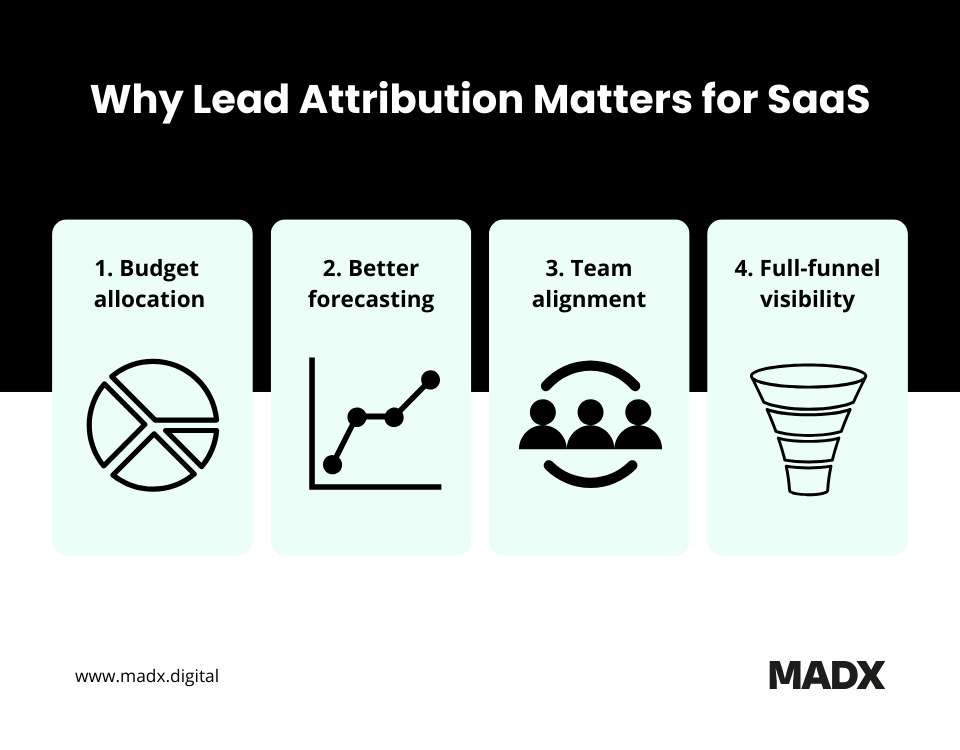
It might seem trivial, but accurate lead attribution matters. More realistic signals allow businesses to make better decisions about budgets, forecasting and more.
1. Budget allocation
Teams invest based on what they believe works. When attribution is wrong, budgets are shifted toward marketing channels that appear to convert (and not those that actually create demand).
SEO and content often go underfunded in businesses as a result, even though they drive a large share of first-touch and assisted conversions.
2. Better forecasting
When you understand how leads actually move through the funnel, forecasts are based on evidence. This allows businesses to improve customer acquisition cost modeling and revenue predictability.
3. Team alignment
Clear attribution reduces confusion around lead sources and handoffs. Sales and marketing teams can see which channels are generating pipeline – and which just filled out the form and left – and align efforts to convert them.
4. Full-funnel visibility
SaaS journeys span content, product, email, sales outreach, and retargeting. Attribution connects those touchpoints into a single narrative rather than isolated metrics.
To measure what really drives conversions, SaaS teams need an attribution model that reflects how users behave in the real world.
The SaaS Lead Journey: Why Attribution Is Complicated
The reality is that SaaS leads rarely convert after a single interaction because the customer journey is complex.
Unaware → Problem Aware → Solution Aware → Product Aware → Most Aware → Sign-Up → SQL → Closed-Won
Within each stage, different channels influence decision-making. A user might discover a problem through organic search, compare tools through paid ads and review sites, engage with email nurture sequences, and finally convert via branded search or direct traffic.
Attribution becomes distorted when only the final interaction is credited. Last-touch models hide the influence of earlier touchpoints, making it appear as though conversions occur in isolation.
Below is a simplified view of how attribution risk appears across the SaaS journey.
| Journey Stage | What Happens | Channels That Influence | Attribution Risk |
|---|---|---|---|
| Problem Aware | User begins researching a challenge or opportunity | SEO content, organic social, community, referrals | Early SEO influence often goes uncredited |
| Solution Aware | User compares approaches or tools | Paid search, comparison pages, review sites | PPC and aggregators receive disproportionate credit |
| Product Aware | User evaluates your product specifically | Email nurture, retargeting, product pages | Influence split across multiple touchpoints |
| Sign-Up | User completes trial or demo request | Direct traffic, branded search, email | Last-touch models over-credit branded channels |
That is why attribution models exist. They help address these blind spots, but only when the model aligns with how buyers actually move through your funnel.
Understanding Lead Attribution Models (and Which Work Best for SaaS)
There is no single perfect attribution model. Each approach answers a different question. The goal is to choose a model that aligns with your growth strategy and buying cycle.
First-Touch Attribution
First-touch attribution assigns 100 percent of the credit to the first interaction that introduced the user to your brand.
For a SaaS company, this might be a blog post ranking for a non-branded keyword or an organic social post shared within a community.
This model is useful for evaluating awareness and top-of-funnel performance, particularly SEO and content marketing. It highlights which channels are responsible for creating demand.
The limitation is that it ignores everything that happens after the initial interaction. It does not reflect how leads are nurtured, influenced, or converted.
Last-Touch Attribution
Last-touch attribution assigns full credit to the final interaction before a conversion event, such as a trial sign-up or demo request.
This model is useful for analyzing conversion rate optimization and user experience at the point of conversion.
Its main limitation is that it consistently overvalues branded search, email, and direct traffic. These channels often capture demand rather than create it, yet they are the primary drivers of revenue.
Linear Attribution
Linear attribution is when credit is distributed evenly across all recorded touchpoints, in other words, a multi-touch model.
For long and distributed SaaS journeys, this model provides a more balanced view than first- or last-touch reporting.
The drawback is that it treats every interaction as equally impactful. A high-intent product demo visit and a low-intent blog visit receive the same weight, which rarely reflects reality.
Time-Decay Attribution
Time-decay attribution assigns more credit to touchpoints closer to the conversion event.
This model works well for B2B SaaS businesses with long sales cycles where late-stage interactions play a stronger role in closing deals.
The trade-off is that early-stage SEO and content still tend to be undervalued, even though they initiate the journey.
Position-Based Attribution
Position-based attribution typically assigns 40% of the credit to the first touch, 40% to the conversion touch, and distributes the remaining 20% across the middle interactions.
For most SaaS businesses, this model offers the best balance because:
- SEO and content are recognized for driving the first interaction
- Sales, product, and brand channels influence the final conversion
- Middle-funnel touches still receive measurable credit
The objective is not mathematical perfection. It is adopting a model that reflects how your buyers actually behave.
Custom-Weighted Attribution Models
Custom-weighted attribution models enable SaaS teams to assign varying levels of credit to touchpoints based on how their buyers actually convert.
Instead of relying on fixed rules, weights are adjusted using historical performance data. For example, early-stage SEO content might receive higher credit for enterprise deals, while product usage or sales outreach may carry more weight later in the funnel.
This approach is useful when:
- Your funnel varies significantly by segment or deal size
- Product-led actions strongly influence pipeline progression
- Sales involvement differs across customer types
For mature SaaS organizations, custom weighting offers flexibility and accuracy. For most teams, starting with a position-based model and evolving over time is the most practical path.
How to Set Up Lead Attribution in Your CRM
Attribution only works when the underlying data is clean, consistent, and connected. Most SaaS teams already have the required tools, but their setup is incomplete. Here’s a simple 5-step process to get your lead attribution running smoothly.
Capture UTMs Automatically
Every form submission should automatically capture UTM parameters. Without consistent UTMs, attribution reporting becomes guesswork.
This includes
- utm_source
- utm_medium
- utm_campaign
- utm_term
These hidden fields should be added to all forms and mapped directly into CRM contact and deal properties. UTMs should persist across sessions wherever possible.
Track First-Touch and Last-Touch Data
Most CRMs support first-touch and last-touch attribution out of the box.
In HubSpot, this includes original source, latest source, and associated drill-down properties. In Salesforce, custom fields or connected attribution tools may be required.
Many SaaS teams also create custom fields, such as 'first page seen' or 'first interaction type,' to add more context.
Connect Product and Marketing Data
In product-led or hybrid SaaS models, form submission should be only the beginning of attribution.
Product usage data from tools like Mixpanel, Amplitude, Google Analytics, or internal event tracking should flow into your CRM. This allows teams to attribute pipeline events to product milestones instead of categorizing them as “marketing activity.”
For example, an SQL might be triggered when a user invites teammates or reaches a feature threshold, not just when a demo is booked.
Align Deal Stages With Marketing Touchpoints
Your CRM deal stages should mirror how leads progress through your SaaS funnel.
Some of the most common SaaS stages include MQL, SQL, demo, and closed-won. Attribution reporting should go beyond the initial conversion and show which channels influence each stage.
This data reveals where SEO, paid media, content, and product activity contribute to pipeline movement.
Automate Reporting
Once the data is flowing correctly, reporting should be automated and accessible. While there are tens, even hundreds of metrics to consider, most dashboards typically include:
- Channel influence across the funnel
- MQLs by source
- SQLs by source
- Revenue by source
- Assisted conversions
When attribution reporting is automated, teams spend less time debating numbers and more time acting on insights.
Once your CRM is capturing clean data, the next step is interpreting it correctly.
How MADX Helps SaaS Teams Understand What Really Drives Conversions
Many SaaS teams rely on attribution models that focus on the final click, which hides the impact of channels like SEO, content, and product-led engagement.
MADX helps SaaS businesses see how leads actually move from first touch to revenue. We build attribution frameworks using the tools you already have. This gives your team a clear, reliable view of which channels influence sign-ups, pipeline, and closed-won deals.
With accurate attribution, your teams can allocate budget more effectively, align sales and marketing around shared data, and make growth decisions with confidence.
Talk to us today to build an attribution model that reflects reality, not assumptions.
Want this done for your brand? Get a free AI visibility audit.
Get my free AI visibility audit
Latest articles
What we've published in the past 30 days — across SEO, GEO, content, and digital PR.

.png)


