GEO
Calculating...
Aug 2026
GA4 launches AI Assistant Channel
GA4 now tracks ChatGPT, Gemini and Claude traffic as its own channel. Here's what the AI Assistant channel measures, what it misses, and what B2B SaaS teams sho

GA4's new AI Assistant channel reports traffic from tools like ChatGPT, Gemini and Claude as its own line, separate from Referral, as of 13 May 2026. It is useful, but it only captures AI visits that arrive with a recognised referrer, so it undercounts AI's real influence. The visits it does catch are small in volume and convert several times higher than organic search.
That is the short version. The detail is where the decisions are, so the rest of this piece covers what changed, what the channel cannot see, how to fill the gaps, and what B2B SaaS teams should do about it.
Key takeaways
- GA4 added a native AI Assistant channel on 13 May 2026. Broad rollout reached most properties around 7 June.
- Qualifying visits get the medium
ai-assistant, channel groupAI Assistant, and campaign(ai-assistant), with no setup. - The native channel only recognises ChatGPT, Gemini and Claude so far. Google has not published the full referrer list, so Perplexity and Copilot coverage is uncertain.
- Between 35% and 70% of AI sessions arrive with no referrer and still land in Direct.
- AI traffic is small (around 6.4% of B2B tech traffic by January 2026) but converts four to five times higher than organic.
- Google AI Overviews and AI Mode are not included. They still report under Organic Search.
What changed in GA4?
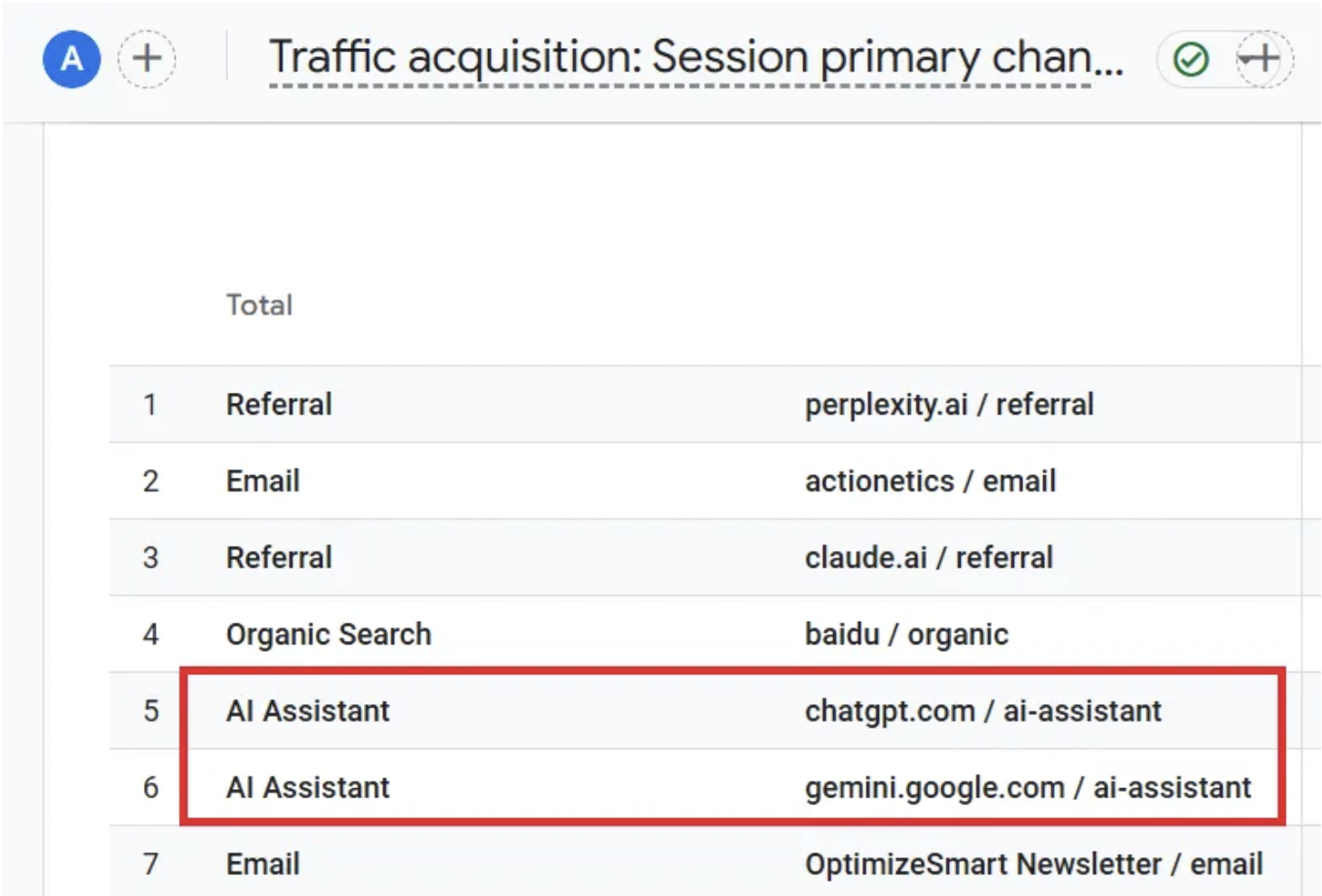
GA4 now tags AI assistant visits automatically. When it detects a referrer matching a recognised assistant, the medium becomes ai-assistant, the channel group becomes AI Assistant, and the campaign reads (ai-assistant). You configure nothing.
Before this, those visits scattered. A recognisable referrer put the session in Referral. A stripped referrer, common inside native mobile apps, dropped it into Direct. AI traffic was tangled with everything else, and isolating it meant building custom regex channel groups that most teams never touched.
The win is visibility. For the first time, a standard report shows how much traffic assistants send, which pages they hit, and how they perform against your other channels. It turns a hunch into a number you can take to a board.
There is a catch worth knowing up front. Google has confirmed the channel recognises ChatGPT, Gemini and Claude but has not published the full list of supported referrers. That leaves real uncertainty about whether Perplexity, Microsoft Copilot, DeepSeek, Grok and others are captured consistently. For most B2B SaaS teams, that means the native channel is a useful start, not a complete picture.
"GA4 can now identify some AI-referred sessions more cleanly than before. It still cannot tell you where your brand appeared inside AI-generated answers, how prominently it was cited or how often those mentions influenced behaviour without generating a click."
Chiara Riva, GA Agency
How much traffic does the AI Assistant channel actually show?
Not much in volume, but what it shows converts unusually well. For most B2B sites, AI traffic is still low single digits of total visits. The quality of that traffic is the real story.
AI referral traffic reached roughly 6.4% of traffic for B2B tech firms by January 2026, up around 975% year over year. Growing fast, still a minority of sessions.
The conversion gap is large. In a study of 312 technology firms, AI-referred visitors converted at 14.2% against 2.8% for Google organic. Semrush put the cross-industry gap at around 4.4 times organic. Seer Interactive, splitting one B2B client by source, recorded ChatGPT at 15.9% and Perplexity at 10.5% against 1.76% for organic.
The engagement difference shows up too. One analysis found AI-referred visitors spend around 68% longer on site and view over three times as many pages per session as the average visitor.
There is a clear reason behind the numbers. Assistants send fewer people, further down the buying process. Roughly 48% of B2B buyers now use AI tools to research software, and someone who asked for a shortlist and clicked your name is evaluating, not browsing. Treat single figures with care, since samples are small and measurement is young, but the pattern repeats across every dataset we have reviewed across our campaigns.
The takeaway: a channel worth a few percent of traffic at several times the conversion rate is worth understanding now, while competition for those citations is light.
What can't the AI Assistant channel see?
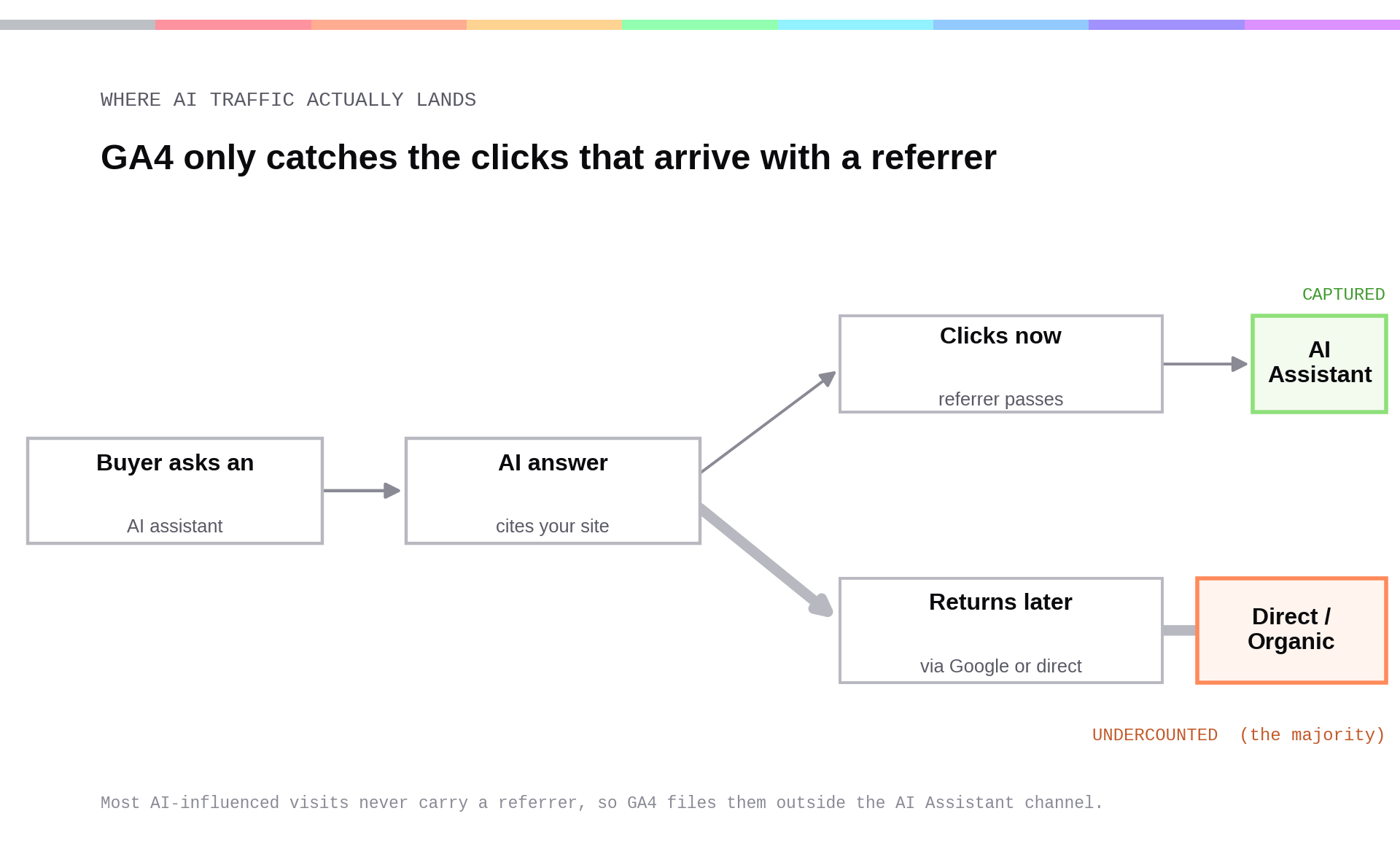
It cannot see any AI visit that arrives without a referrer GA4 recognises, and that is a large share of them. This is the channel's core limitation.
The referrer goes missing in predictable ways. The assistant runs in an app that strips it. Or someone reads the answer, notes your name, closes the app, and returns days later through branded search or a direct visit. The assistant did the persuading. GA4 credits Direct or Organic.
The scale of the gap is significant. Depending on the source, between 35% and 70% of AI sessions arrive with no referrer and fall into Direct, and the visits that disappear are often the most influential.
The channel also says nothing about the answer itself. Not the question asked. Not whether you were recommended or listed as an afterthought. Not which competitors shared the response. You see the click, never the conversation behind it.
Here is the distinction worth keeping. GA4 shows you some AI-assisted clicks. It cannot show you most AI-influenced decisions.
Where AI traffic gets attributed in GA4
ScenarioGA4 attributionClick from ChatGPT, Gemini or Claude, referrer intactAI AssistantClick from another assistant Google hasn't listedReferral (or AI Assistant, inconsistently)Click from a mobile assistant app, referrer strippedDirectReads the answer, returns later via GoogleOrganic or branded searchClick from a Google AI Overview or AI ModeOrganic Search
How do you fill the gaps the native channel leaves?
Build your own custom channel group with a regex filter, and run it alongside the native channel. The native channel covers the three named assistants. A custom group lets you capture every platform you care about and define the rules yourself.
The setup takes a few minutes in GA4. Go to Admin, then Data Display, then Channel Groups, create a new group, and add a channel called "AI Search." Set the condition so that the source matches a regex covering the platforms you want, then drag that channel above Referral so it takes priority. It applies to historical data, so you see past AI traffic reclassified straight away.
A practical starting pattern looks like this:
chatgpt\.com|chat\.openai\.com|openai\.com|perplexity\.ai|claude\.ai|gemini\.google\.com|copilot\.microsoft\.com|deepseek\.com|grok\.com|meta\.ai|you\.com
From there, read AI traffic through three views rather than one. Look at source and medium to see which assistant is doing the work, since ChatGPT, Perplexity and Gemini behave differently. Look at the channel group to track total volume over time. Look at landing pages to see which content earns the visits.
Add a comparison period, for example the previous 28 days against the current 28, so you can tell whether a content change moved anything. The pages that show up most often in this report are the ones assistants already trust enough to cite. Treat those as your highest-value AI assets and build more like them.
Are Google AI Overviews included in the AI Assistant channel?
No. Clicks from AI Overviews and AI Mode still report under Organic Search, because they happen inside Google's own search results rather than a standalone assistant.
This matters because AI Overviews will shape search behaviour more than chatbot referrals for many B2B SaaS brands. You can appear constantly inside AI summaries while outbound clicks fall. Visibility rises, click-through drops, branded search climbs later.
To see Overview influence, you have to look outside the AI Assistant channel entirely: impressions and click-through rate in Search Console, plus branded search trends over time. The reporting challenge runs across several surfaces at once, not one tidy channel.
Why does this matter for how B2B buyers research?
Because assistants have become a normal first stop for the considered, expensive decisions B2B SaaS sells into. The buying research is moving off Google.
Buyers now ask things like "best CRM for a 50 person SaaS company," "how does HubSpot compare with Salesforce," or "which agency does B2B SaaS SEO." These are commercial questions, the ones that happen right before a demo or a vendor shortlist.
"By placing AI referral traffic alongside Organic Search in default reports, Google is telling marketers that AI assistants are a distribution surface to optimize for, not just monitor."
Cecilia Meis, Semrush
That is the real signal. The channel is Google conceding that assistants are a place to compete. This is the core of Generative Engine Optimisation (GEO), the practice of earning visibility inside AI-generated answers, and it is now measurable enough to defend with a number.
How should you write content to get cited by AI assistants?

Write the kind of pages assistants quote: clear, specific answers to real buying questions, backed by evidence. Assistants do not show ten links and step back. They write the answer, then cite the few sources that earned it.
In practice, the pages that get cited are comparison pages, alternatives pages, buyer guides, pricing explainers, integration pages, and original data. The pages that answer a buying question without making the reader dig. Generic blog posts do not get cited.
A few moves consistently help your content get referenced:
- Answer the question in the first lines. Assistants pull the cleanest, most direct answer, so lead with it and add depth below.
- Make claims verifiable. Specific numbers, dates and named sources get pulled far more than vague assertions.
- Earn third-party mentions. Presence in independent buyer guides, comparison posts, G2 and Capterra, and relevant Reddit and Quora threads is what assistants lean on most.
- Keep your entity data consistent. State your brand name, category and description the same way across every external property.
This is where AI search and traditional SEO diverge. Classic SEO gets you found in Google. AI search work, what we call Link Building 2.0, gets your brand mentioned and chosen inside the generated answer.
The main input is third-party brand mentions in buyer-intent content, not the volume of posts on your own blog. More content does not fix this. Being referenced in the right comparison and buyer-guide content does.
Put simply: AI does not rank you. It references you, and only if you have given it a reason to. Our SaaS search learning hub covers how this plays out for software companies.
What should B2B SaaS teams do now?
Start with the baseline, layer in the missing platforms, then move to citations. Here is the order we use.
- Confirm the channel exists in your property, then record today's sessions and conversions as a baseline. Month-on-month movement matters more than any single total.
- Build a custom channel group with the regex above, so Perplexity, Copilot and the rest are not stuck in Referral or Direct.
- Check robots.txt is not blocking assistant crawlers (ChatGPT-User, OAI-SearchBot, Perplexity-User, Claude-SearchBot). An assistant can only cite a page it can read.
- Compare commercial performance, not volume. Put AI conversion, engagement and assisted conversions next to Organic Search. The quality gap is the story.
- Find your cited pages. The landing pages earning the most AI traffic are the templates to repeat.
- Test your highest-intent buyer prompts in each assistant to see whether you appear at all, then build the comparison and buyer-guide content that earns the citation.
Treat the early numbers as directional. They are a useful signal, not a complete measurement model.
Conclusion
This is not really about GA4. It is about the buyer changing underneath us.
For years the path was Google search, site visit, conversion. That path still exists, it is just no longer the only one, and increasingly not the first. A buyer can ask an assistant for a shortlist, click a citation, compare elsewhere, return through Google, and convert weeks later on a channel that takes the credit.
That makes measurement harder and being visible inside the answer more valuable. GA4's AI Assistant channel is not the last word on AI attribution. It is a signal that AI discovery is now normal enough to measure, and once something is measurable, it gets much harder to ignore.
Want to understand how AI search is shaping your own pipeline, and how to earn the citations that drive it? Book a call with our team.
Frequently asked questions
What is the AI Assistant channel in GA4?
It is a default channel group GA4 now applies automatically to visits from recognised AI assistants such as ChatGPT, Gemini and Claude. Those sessions receive the medium ai-assistant, the channel group AI Assistant and the campaign (ai-assistant), with no setup required.
When did GA4 add the AI Assistant channel?
Google documented the change on 13 May 2026, with broad availability across properties around 7 June. The rollout was gradual, so some accounts saw the channel weeks before others.
Does the AI Assistant channel capture all of my AI traffic?
No. It only catches visits arriving with a referrer GA4 recognises. Many AI visits carry no referrer, especially from mobile apps, or return later through Direct and branded search, so they are attributed elsewhere. Referrer-based estimates suggest it captures only around 60 to 80% of AI-sourced traffic, and it misses the visits where the assistant shaped the decision before any click.
Does the AI Assistant channel include Google AI Overviews?
No. Clicks from AI Overviews and AI Mode still report under Organic Search, because they happen inside Google's own search results rather than a standalone assistant. Measuring AI Overview influence requires looking at impressions, click-through rate and branded search trends, not the AI Assistant channel.
Why does AI traffic convert higher than organic search?
Because of where it sits in the buying journey. People arrive after asking an assistant for a recommendation or comparison, so they reach you already evaluating rather than browsing. Multiple 2026 studies put the conversion rate at roughly four to five times organic, though volumes are still small and figures vary by source.
How do I make sure AI assistants can cite my B2B SaaS site?
Confirm your robots.txt is not blocking their crawlers (ChatGPT-User, OAI-SearchBot, Perplexity-User, Claude-SearchBot) and that key pages render in a way those bots can read. Then invest in the comparison pages, alternatives pages and buyer guides that assistants pull from when they build recommendations, since being cited depends far more on third-party buyer-intent content than on the volume of posts on your own blog.
Want this done for your brand? Get a free AI visibility audit.
Get my free AI visibility audit.png)
Latest articles
What we've published in the past 30 days — across SEO, GEO, content, and digital PR.


