SEO
Calculating...
Jun 2026
Six Google Updates From the Last Month, and What They Mean for B2B SaaS
Google I/O, the May 2026 core update, GA4's AI Assistant channel, and new AI visibility reporting in Search Console. What the last month means for B2B SaaS.

Search changed more in the last four weeks than it did in most of last year. Google held its biggest I/O in years, published its first official guide on AI search, pushed a core update that moved rankings, and added AI visibility reporting to two of its core tools.
Most roundups list everything. This one only covers the six that change how you think about visibility, measurement, or both. For each, we explain what people assume, what is actually happening, and what we would do about it across a B2B SaaS account.
If you only have two minutes, the TLDR below is the version to skim.
TLDR
The six updates worth your attention:
- Google I/O confirmed that Search is now AI Search by default, with over a billion monthly AI Mode users.
- Google's first official AI search guide says there is no separate AI strategy. It is foundational SEO applied to a new surface.
- The May 2026 core update was a big one, with real ranking volatility across verticals.
- GA4 added an AI Assistant channel, so ChatGPT, Gemini, and Claude traffic finally gets its own row (with caveats).
- Search Console now reports AI visibility, showing impressions in AI Overviews and AI Mode, but no click data.
- FAQ rich results are gone, with reporting and testing support retiring through the summer.
The thread running through all six: visibility is moving from "where do I rank" to "am I the source the AI cites." That shift is what our AI search work is built around.
1. Google I/O: Search is now AI Search by default
At I/O on May 19, Liz Reid, Google's VP of Search, put it plainly: Google Search is AI Search through and through. That is not a tagline. AI Mode now serves over a billion people a month, and AI Overviews reach 2.5 billion.
Google also called the new search box the biggest upgrade in 25 years, made Gemini 3.5 Flash the default model in AI Mode, and previewed background agents that browse the web on a user's behalf.
What people assume: this is more of the same AI hype, and the ten blue links will still be there underneath.
The reality: the results page you have spent years optimising for is being replaced by an answer. That answer is assembled from sources Google trusts, and the user often never scrolls past it. Ranking number one matters less when position one is a citation inside a paragraph, not a clickable headline at the top.
What we would do: stop treating "rank for the keyword" as the finish line. The work now is making sure your brand is one of the sources the AI pulls from. That means earning mentions in the comparison content and buyer guides these models lean on, which is the core idea behind Link Building 2.0.
You can read Google's own I/O search recap for the full feature list.
2. Google's first official guide on optimising for AI search

On May 15, Google published its first consolidated guide on showing up in AI Overviews and AI Mode. John Mueller announced it on the Search Central blog, and the guide now sits in a new "Generative AI fundamentals" section of the documentation.
The headline is the part most people skipped: there is no separate AI strategy. In Google's own framing, AEO and GEO (Generative Engine Optimisation, optimising to be cited in AI answers) are just foundational SEO applied to a new surface.
The guide also names tactics that are quietly wasting budget. Generic summary content that an AI could write itself adds no citation value. llms.txt files get no special treatment from Google's crawler. You do not need to chunk your content into tiny pieces, and you do not need AI-specific rewrites of existing pages.
What people assume: AI search needs a brand new playbook, new file types, new schema, new everything.
The reality: the fundamentals that already work (unique, expert-led content and genuine third-party signals) are what earn inclusion. Google explicitly warned against chasing inauthentic mentions, which is worth reading carefully, because it is not an argument against mentions. It is an argument against fake ones.
What we would do: double down on non-commodity content and real placements, and stop paying for shortcuts that Google has now said it ignores. If your technical foundation is shaky, that still matters, and our SaaS technical SEO guide covers the basics worth keeping clean.
Sources: Google's announcement and the full guide.
"There is no separate strategy for AI search. AEO and GEO are foundational SEO applied to an AI surface." This is the line the whole guide rests on, and it should settle a lot of the noise from the last year.
3. The May 2026 core update, and it was a big one
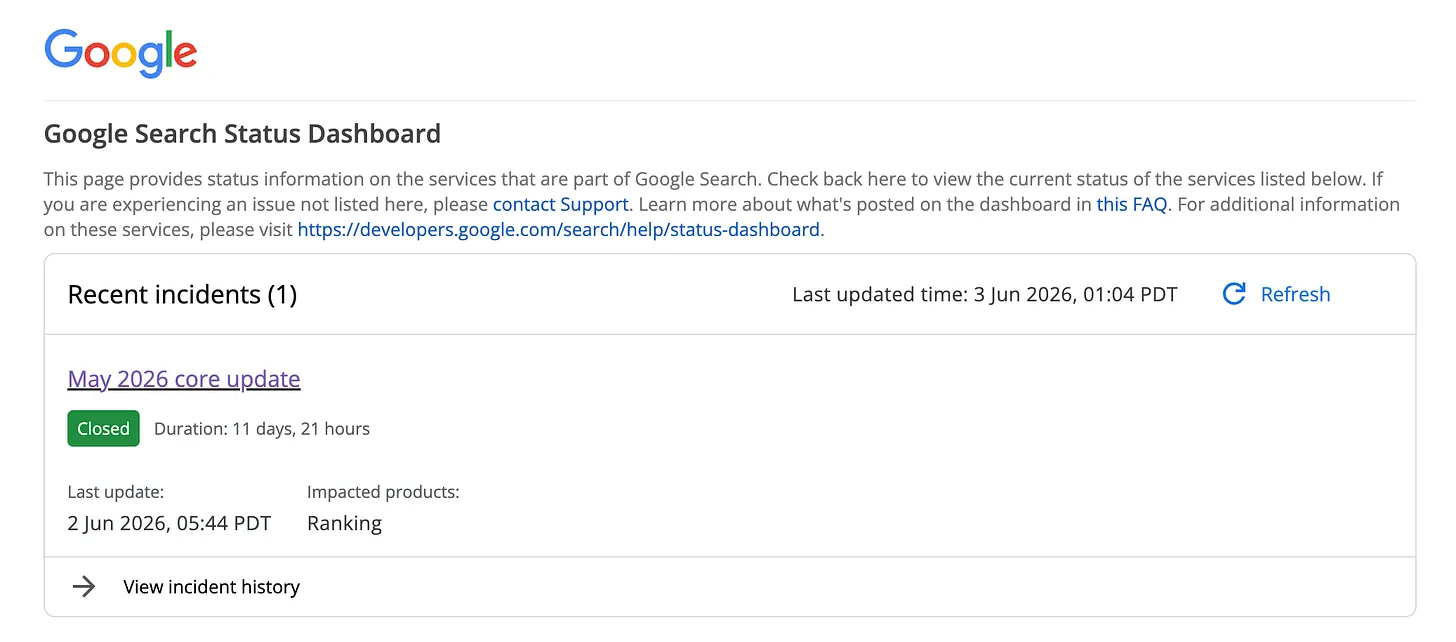
The core update started rolling out on May 21 and finished around June 4. Unlike the March update, which most practitioners found underwhelming, this one moved things.
Lily Ray at Amsive and Glenn Gabe at G-Squared Interactive both flagged heavy volatility across verticals and countries over the rollout, with movement at several points rather than just the start and finish.
What people assume: rankings dropped, so something on the site broke and needs fixing immediately.
The reality: mid-rollout data is not clean data. Rankings shuffle while the update settles, and reacting in the middle of it is how good pages get changed for no reason. Core updates are a broad re-evaluation of quality signals, not a targeted penalty.
What we would do: hold off. Wait until the rollout completes, give it a full week, then compare against a clean pre-update baseline. May 14 to 20 is your window. If a page genuinely lost ground after that, the question is whether a competitor's content now answers the query better, not whether you broke a technical rule.
Sources: Search Engine Land on the rollout and Search Engine Journal on the volatility.
4. GA4 now has an AI Assistant channel
This is the one most teams will actually use day to day. As of May 13, GA4 added a native "AI Assistant" channel to the Default Channel Group. Traffic from ChatGPT, Gemini, and Claude now gets its own row in your acquisition reports, with no regex and no custom setup.
Before this, AI referral traffic landed in the generic Referral bucket, indistinguishable from a link in a news article. Most teams never built the custom channel group needed to separate it out.
What people assume: this finally solves AI attribution, and the numbers in that row are the full picture.
The reality: it captures less than it looks. The channel only catches traffic with a clean referrer, so clicks from in-app browsers, mobile apps, and copy-pasted links still land in Direct. And it explicitly excludes AI Overviews and AI Mode, which Google still counts as Organic Search.
What we would do: add an annotation in GA4 on May 13 so everyone remembers the baseline shifted, then treat the new row as a floor on AI traffic, not the ceiling. It tells you the direction of travel, not the absolute number. Attribution remains the hardest problem in this space, which is exactly why measurement deserves more attention than rankings right now.
Source: Search Engine Journal's breakdown.
5. Search Console now reports AI visibility
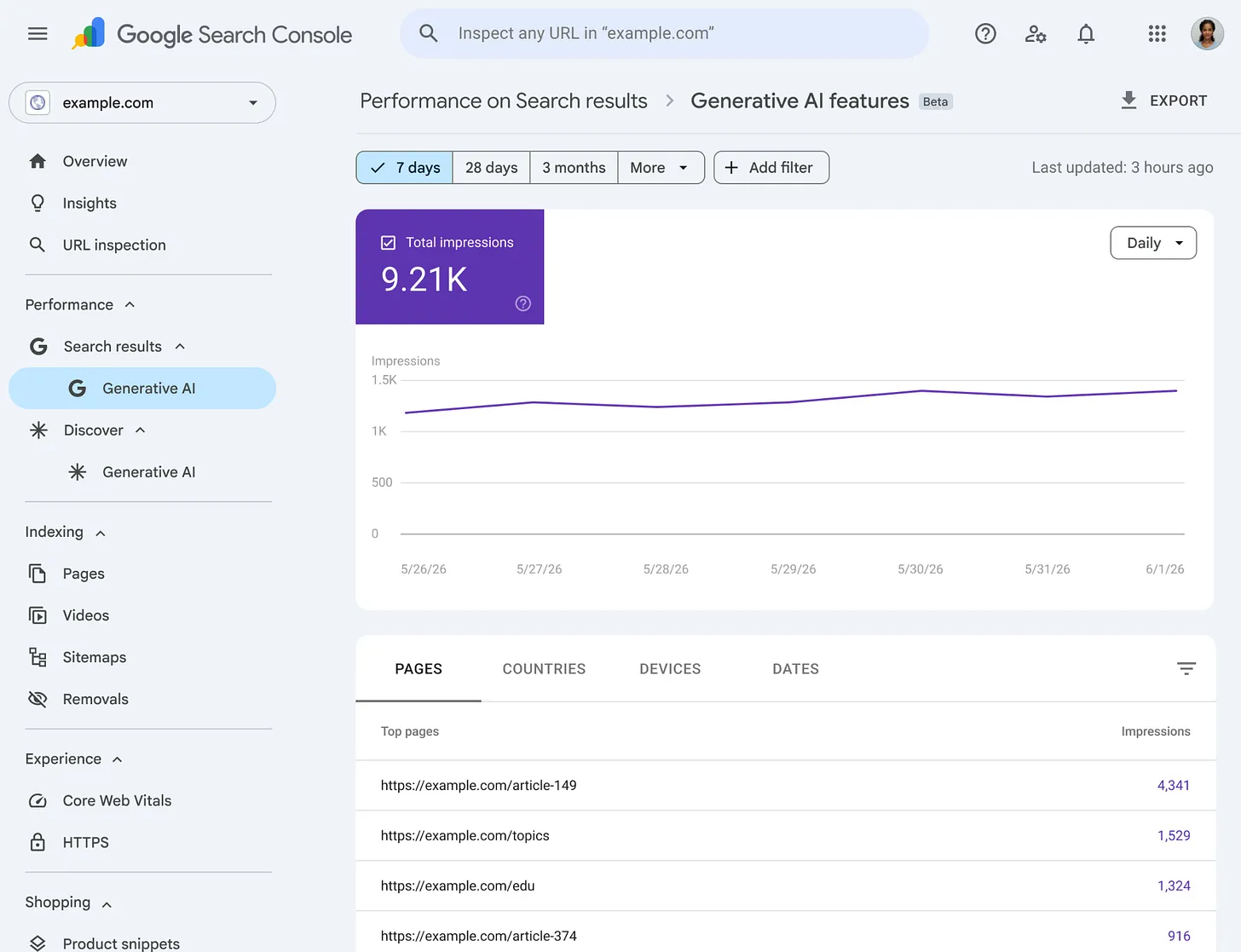
This landed on June 3. Google is rolling out a new Search Generative AI performance report in Search Console, with dedicated views for how your site shows up in AI Overviews, AI Mode, and the generative features in Discover.
For the first time, you can measure AI presence inside Google's own tool rather than inferring it from third-party platforms.
What people assume: finally, full data on how AI search drives traffic to the site.
The reality: the report covers impressions, pages, countries, devices, and dates, but no click data. You will see whether you appear in AI answers, not how many people clicked through from them. Google is also testing a toggle to block your content from AI Mode and Overviews entirely, which is a separate decision worth thinking through before anyone flips it.
What we would do: set up the report now and start logging where you appear, before you need that history in a quarterly review. Impressions without clicks is still a useful signal. It tells you which pages and topics the AI considers you a credible source on, which is the leading indicator for citation visibility.
Sources: Google's announcement and Search Engine Land's coverage.
"Today we are launching a separate view dedicated to visibility from generative AI features." For B2B SaaS teams that have been guessing at AI presence, this is the first native baseline Google has offered.
6. FAQ rich results are gone
Easy to miss with everything else going on, but worth a line in your reporting plan. Google stopped showing FAQ rich results on May 7. It retires the Search Console reporting for them in June and pulls FAQ support from the Rich Results Test in August.
What people assume: FAQ schema is still a quiet CTR win worth maintaining.
The reality: that lever is closed. The expandable question-and-answer dropdowns that used to grab extra space in the SERP are gone, and the reporting that tracked them is going with them.
What we would do: if your dashboards track FAQ appearances or pull FAQ data from the Search Console API, plan around the June and August retirements now. Keep FAQ content where it genuinely helps a reader, but stop counting on the rich result. It is a small change, but it fits the pattern in everything above: markup shortcuts are losing ground, and original, credible content keeps winning.
Source: SWOT Digital's summary.
What this adds up to
Read the six together and one pattern runs through all of them. Visibility is moving from "where do I rank" to "am I the source the AI cites." Google said it directly in the AI search guide, the I/O announcements assume it, and the new reporting in GA4 and Search Console is built to measure it.
Three things we would do this month, in order.
First, set up the new GA4 channel and the Search Console AI report so you have a baseline now, before you need it. Second, hold off reading too much into rankings until the core update fully settles. Third, stop treating AI search as a side project, because Google just confirmed it is the main one.
If you want to see where you currently stand, we run an AI visibility benchmark that shows where your brand is being cited versus your competitors across AI answers. You can find our AI search services here, or browse the free resources if you would rather start on your own.
Frequently Asked Questions
Did the May 2026 core update penalise my site?
Core updates are not penalties. They are a broad re-evaluation of how Google judges content quality across the whole index. If your rankings dropped, it usually means competing content now answers the query better, not that you broke a rule. Wait until the rollout finishes, give it a week, then compare against a clean pre-update baseline before changing anything.
Does the GA4 AI Assistant channel include traffic from Google AI Overviews?
No. The AI Assistant channel covers referrals from chatbots like ChatGPT, Gemini, and Claude. Traffic from Google's own AI Overviews and AI Mode is still classified as Organic Search. So the new channel only shows part of the AI picture, and it misses any AI clicks that arrive without a clean referrer.
How do I track AI search visibility in Search Console?
As of June 3, Search Console has a dedicated Search Generative AI performance report showing your impressions in AI Overviews, AI Mode, and Discover. It includes impressions, pages, countries, devices, and dates, but not click data. Set it up now so you build a history of where you appear, which is a useful leading indicator even without clicks.
Do I need a separate strategy for AI search and traditional SEO?
According to Google's May 2026 guide, no. Google frames optimising for AI features as foundational SEO applied to a new surface, not a separate discipline. Unique, expert-led content and credible third-party mentions are what earn citations in AI answers, the same signals that have always supported strong rankings.
Is FAQ schema still worth adding to my pages?
The FAQ rich result in Google Search is gone as of May 7, 2026, so it no longer earns extra space or CTR in the SERP. You can keep FAQ content where it genuinely helps readers, and FAQ schema can still support understanding, but it should no longer be maintained purely for the rich result, since that benefit has been removed.
Want this done for your brand? Get a free AI visibility audit.
Get my free AI visibility audit.png)
Latest articles
What we've published in the past 30 days — across SEO, GEO, content, and digital PR.