Content
Calculating...
Aug 2026
B2B Content Writing Guide - Types, Process, Services, and More
Learn what B2B content writing is, explore the key content types, how the process works, and what to look for when hiring a B2B content writing service.


There’s good B2B content writing, and there’s the opposite. The latter focuses on pumping out dozens of keyword-shaped content pieces a week rather than intent-shaped pieces your technical audiences need.
On the other hand, good B2B content writing takes into account your audience’s pain points, competitors, a nuanced long sales cycle, and the decision-making process of your target audience, which often involves multiple stakeholders.
Then you use those insights to design a content strategy and product-led pieces that drive pipeline revenue growth.
In this article, we’ll explain how this works and share the steps for creating content that delivers measurable results.
What We'll Cover
What is B2B Content Writing?
B2B content writing, also business-to-business, means writing content that helps your business attract, educate, convert, and retain other businesses as customers.
Take MADX Digital, a leading B2B SaaS copywriting and search agency, as an example. We create case studies showing how we helped other businesses scale their visibility and organic pipeline revenue.
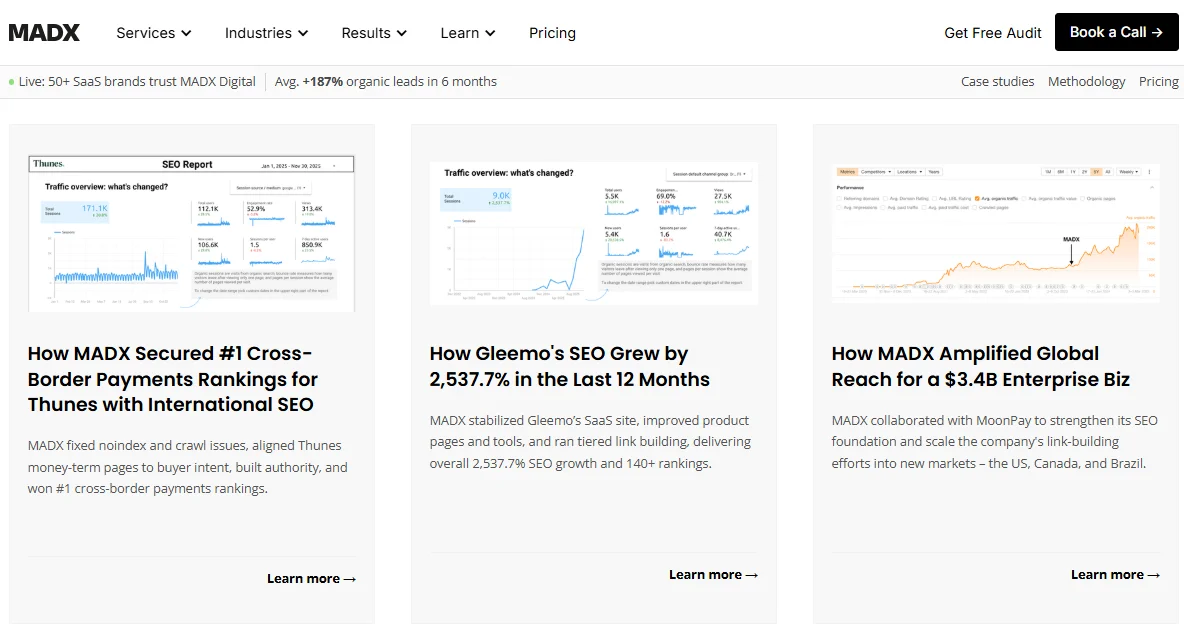
When businesses with similar pain points read these case studies, they see our services as a solution, and that moves them closer to a buying decision.
The Core Types of B2B Content
These include blog posts, long-form guides, case studies, whitepapers, email sequences, and email newsletters.
Blog Posts and Long-Form Guides
A blog post is the most common SaaS content writing format, and it forms clusters around topics relevant to what you sell.
Most B2B blog posts are long-form, with a word count of 1,000 to 7,500 words, or over 10 minutes of reading time. An example is this post you are reading.
Blog posts fit in different stages of the marketing funnel. The top funnel creates awareness, the middle builds trust and credibility with in-depth guides, while the bottom funnel aids conversion.
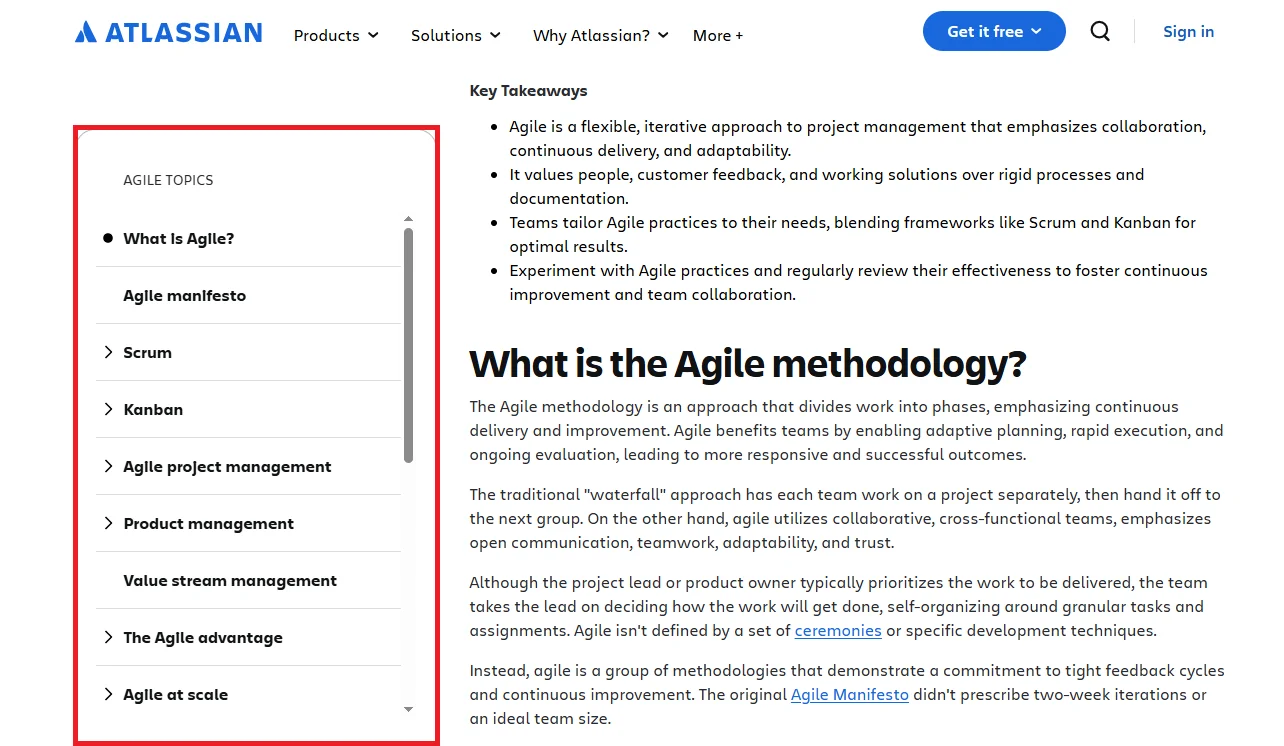
Long-form guides, on the other hand, cover the entirety of a topic and are broken into multiple chapters. Each chapter focuses on a subtopic and explains everything there is to know about it. Structured well, these guides double as pillar pages that anchor your topic clusters.
Atlassian’s long-form guide on Agile Methodology is a perfect example of that.
MADX Digital combined product-led research and content strategy involving these two formats to drive Polystatic’s traffic up by an additional 75,000+ per month.
See how our content team can help you achieve even more.
Case Studies and White Papers
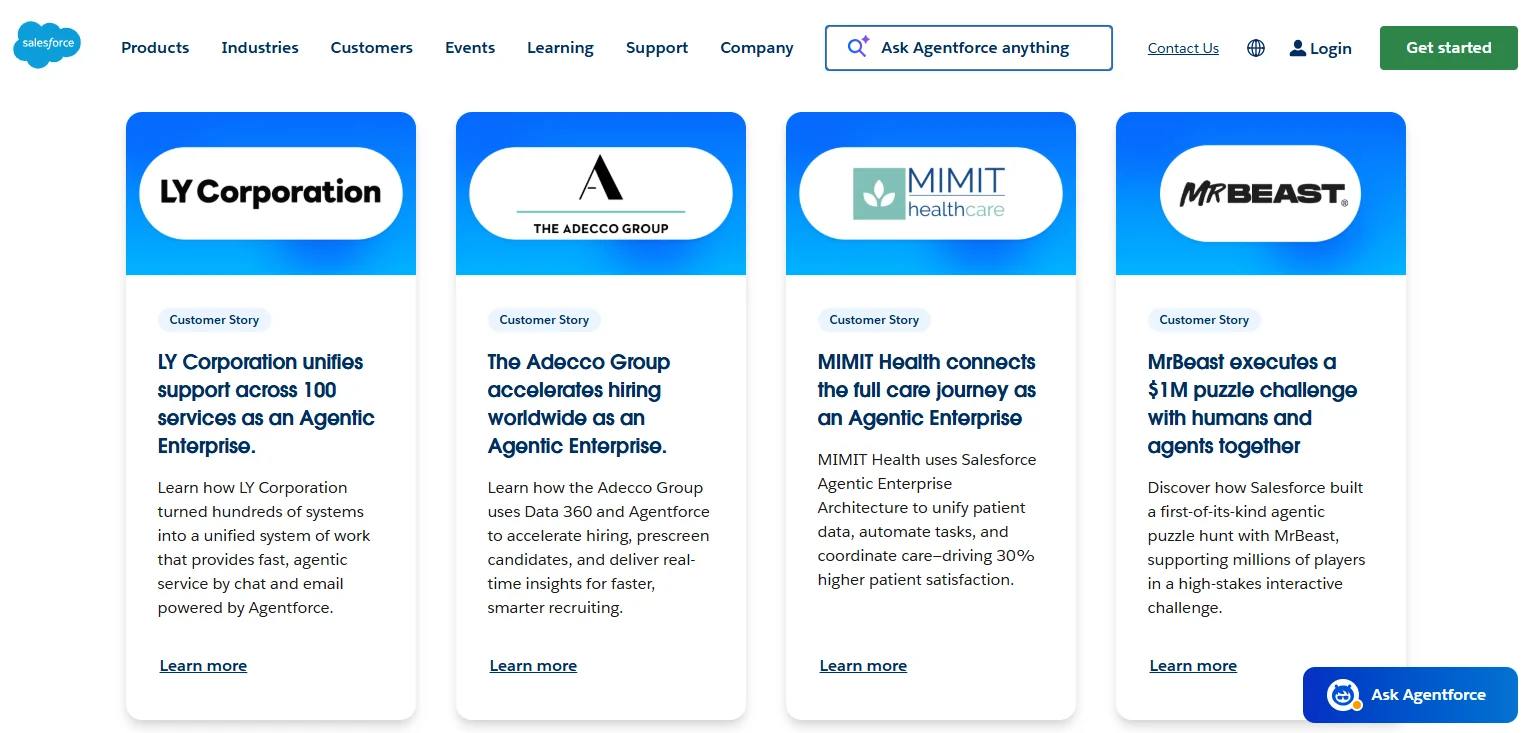
Case studies are concise content that show how your product solved a problem for other businesses.
Buyers at the consideration stage use this to refine their decision-making and to answer questions like, “Can your product solve this problem?”
That’s how Salesforce aids buyers’ decisions to purchase AgentForce, as shown below.
A whitepaper is a long, in-depth document that addresses a problem in your industry. Unlike case studies and blog posts, it does not sell your product or put it in the spotlight.
It’s more or less a research report and focuses on building trust, credibility, and authority. Most whitepapers are gated, meaning your target audience must provide personal details, such as an email address, to access them.
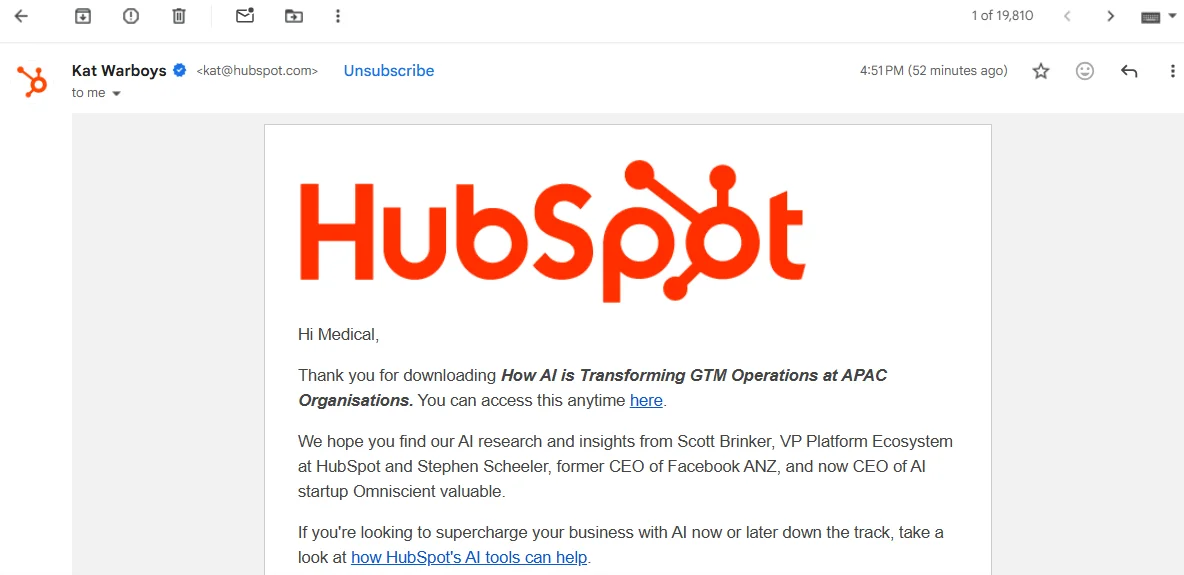
Serves as an effective lead magnet. See how HubSpot’s whitepaper below.

Email Sequences and Newsletters
Email sequences are a series of prewritten emails sent automatically to a B2B lead over time.
One thing to note is that these sequences are triggered by an action.
For instance, when someone submits their email address to download your whitepaper, your email system automatically sends them the material.
Subsequently, they receive other resources, such as case studies, an invitation to a demo, a pricing breakdown, and so on, until the sequence ends or a sale is made. So, email sequences focus on nurturing leads through a long sales cycle.
In contrast, an email newsletter is regularly scheduled and sent to your entire email subscriber list. That means it’s not triggered by any action.
The purpose of newsletters is to engage your audience, whether existing buyers or prospective leads. In the long run, a lead who’s not ready to buy today might decide to do so in six months’ time because they’ve been reading your newsletter.
What Makes B2B Content Writing Effective?
What makes B2B content writing effective comes down to five things:
- Role Specificity: You take one role per piece of content instead of trying to address CFOs, CMOs, IT directors, content lead, business owners, and finance all at once
- Funnel Positioning: Good B2B content writing maps each piece to a funnel stage rather than using a single post to cover it all
- Problem Orientation: B2B content should be product-led, but it starts with your B2B audience’s problems and helps them see you understand what they go through
- Clear Point of View: A single B2B pain point can have multiple perspectives, but good writing picks one and defends it with facts or results. This streamlines your buyers’ decision-making process
- Measurable Commercial Outcome: Outcome is built into your B2B marketing strategy right from the start. That means each piece of content has a goal. Some to create awareness, some to drive retention, and others to drive buy-in or prompt readers to take action.
The B2B Content Writing Process
The B2B content writing process includes research, topic selection, brief creation, drafting and editing, and distribution with performance tracking.
Audience Research and Buyer Persona Development
B2B audiences are a mix of decision-makers, including C-suite executives like CEOs and CFOs, VPs of marketing or IT directors, and content leads or engineers.
You need to know which of these people holds the helm when it comes to buying, the problem they want to solve, and how urgently they need it.
- Ask your teams: Support knows who raises a ticket when things go south, the issues they raise, and other details. The product team knows which features were most used and which ones sit in the corner
- Ask existing customers: Share a survey with an incentive, such as a discount, to boost participation. Figure out who makes decisions in their organization, what made them choose you, and the problems faced
- Check Review sites: Sites like Capterra and G2 house buyer reviews and complaints. You can identify who’s making the complaint and what blockers they face from there
- Use Socials: Search for topics relevant to your brand and jump on threads that feature those topics. You’ll see your target audience discussing their pain points there
- Check search: Use tools like Ahrefs or Semrush to find out the queries people search for when looking for the solution you provide
Collate insights from this research to define your ideal buyer persona. You can use HubSpot’s persona tool to create one.
2. Topic Selection and Keyword Mapping
The problem your product solves, and the pain points in your buyer persona, tell you what topic to write about.
But before going ahead, you need to know how many of your buyers are searching for these topics and how competitive it is to rank for them.
Use Ahrefs or Semrush to find the monthly search volume and associated keywords, along with their keyword difficulty.
Also, map each keyword to a funnel stage. For instance, “What is enterprise SEO” falls in the top of the funnel (TOFU). This ensures you cover the full buying journey and that each piece has a purpose.
3. Content Brief and Writer Briefing
A content brief covers information about your brand and the instructions your writers should follow when writing. It must be comprehensive enough and brief your writer concerning the following:
- Information about your brand or the one being written for, including tone, personality, style, brand voice, brand dos and don’ts
- Keywords, audience data, and competitors
- Article topic, guidelines, research links, competitor sources, and internal linking suggestions
- What competitors are doing, gaps to cover, intent, and angle
- Article outline, with a short brief per heading to align with the writer
The more comprehensive, the better. Update your brief based on the topic and the results you achieve with each piece of content. If the last piece’s tone is off, then adjust it in the brief for the next topic.
4. Drafting, Editing, and Quality Review
Prior to drafting, your writers need to digest the brief and do their own thorough research on the topic before writing a single line.
Should your writers use AI? It depends.
If it is to complement research, like break down a term or explain a sentence, that’s fine. But they can’t depend on it or use AI to heavylift their process. AI sometimes hallucinates, creates incorrect facts, and the content can sound monotonous.
Also, design an E-E-A-T writing checklist that your writers must check before submission. The editors also need a checklist highlighting things to tick off, like:
- Intent and alignment
- Keyword use
- Grammar, accuracy, and fluffs
- Coverage and gaps
Ensure each piece of content produced communicates your intended message, meets or passes baseline, and achieves the goal you set during quality review.
5. Distribution and Performance Tracking
Search engines like Google remain the primary for distribution. For social media platforms, 80% of B2B marketing leads come from LinkedIn, so that’s a good place to distribute the published content or create social posts.
Other channels include Twitter and email newsletters. You can freshly create new emails or simply repurpose your published blog content.
94% of buyers use large language models (LLMs) when making purchasing decisions. While you can’t particularly distribute your content on AI engines, you can optimize it so that LLMs bring it up when buyers ask related questions:
- Write clear answers after every question before explaining
- Use FAQs where possible
- Keep answer blocks short
After distribution, use Google Console to check for changes in traffic and the keywords or search terms you rank for. You can use Ahrefs or Semrush to monitor organic pipeline revenue metrics such as MQLs and the MQL-to-SQL conversion rate.

Common Mistakes in B2B Content Writing
Some of the most common B2B content writing mistakes you can make and should avoid include:
- Writing for every stakeholder or multiple figureheads at once. Tailor one piece to a stakeholder, or two at most. They understand different languages and shouldn’t be lumped together
- Prioritizing quantity over quality. AI has made content creation easy, but it has also made quality content creation harder and more valuable. Prioritize quality and human-standard output
- Measuring success via traffic. Traffic has no value if it doesn’t convert. So focus on organic pipeline revenue metrics like MQLs and MQL-to-SQL rates
- Distributing to channels where your audience is not. You’ll end up attracting the wrong audience. Avoid that by identifying the channel your buyers already spend time on
What to Look for in a B2B Content Writing Service
Certain marketing agencies provide B2B content writing services. Before choosing one, consider these:
- Industry Expertise and Subject Matter Knowledge: Filter out agencies providing generic content services. Look for those who primarily specialize in the B2B niche and have built a credible reputation around their service through quality delivery
- SEO and Content Strategy Capabilities: Your go-to agency should understand keyword strategy, funnel mapping, and how to build topical authority. You can check their case studies for clues or request a demo
- Process Transparency and Quality Standards: Ask how they handle briefs, revisions, and editorial review. If you need more independent answers, check out review sites like G2 or Capterra

Where Does B2B Content Writing Fit in Your Growth Strategy?
If you rely on only paid ads to boost your product’s visibility and sales, you’re going to burn out fast.
That’s where B2B content writing comes in. It maintains your organic pipeline, significantly slashes paid expenses, and helps you build a community of audiences who trust you.
However, an effective B2B content writing program requires significant effort and can be more expensive if done in-house. Besides, your team might not have the necessary resources to sustain one.
Alternatively, you can outsource it to MADX Digital, a B2B SaaS search agency. Our B2B content writing services entail:
- Thorough market, audience, and competitor research
- Audience alignment and funnel mapping
- SaaS-specific writing and production
- Brand voice consistency and editorial quality control
- Performance tracking and refinement
Ready to give it a try? Book a call today.
Frequently Asked Questions (FAQs)
Here’s what content leads, business owners, and marketing managers are asking.
What Is the Difference Between B2B and B2C Content Writing?
B2B content writing means writing content that helps one business, yours in this case, sell to another business. Buyers are a group of stakeholders making high-value decisions, and the sales cycle is long.
B2C content writing means creating content that helps a business sell directly to consumers. The buyer is an individual, the sales cycle is shorter, and the buying process is more emotional.
How Much Does B2B Content Writing Cost?
For an in-house program, you might spend up to $20,000 per month to produce 10 pieces of content, considering the cost of your writers, SEO team, and tools used. If you’re outsourcing it to a marketing agency, a solid content program with up to 10 pieces per month can cost $6,000 or more.
How Long Does It Take to See Results From B2B Content Writing?
Results typically start showing within the first month if you do it right. But you need to set your review cadence to at least two to three months before seeing a tangible impact on your pipeline revenue.
Can B2B Content Writing Work for SaaS Companies?
Yes, it will. SaaS companies are often B2B, and content is one of their highest-ROI channels. Buyers in this niche require content tailored to their needs and their entire buying journey. B2B content writing provides that.
Want this done for your brand? Get a free AI visibility audit.
Get my free AI visibility audit.png)
Latest articles
What we've published in the past 30 days — across SEO, GEO, content, and digital PR.


